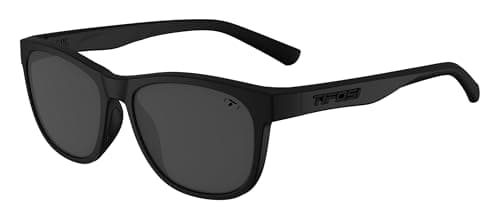
Buy a light sport frame that will not move when you lunge, in a tint that lifts a yellow-green ball out of the background. The Tifosi Swank XL is our pick for most players because it is barely-there light, grips as you sweat, and comes in a size that suits wider faces; the standard Swank is the same frame for narrower ones. If you play a lot at the kitchen line, understand that ordinary sunglasses are not certified impact protection.
Pickleball has a specific eyewear problem that tennis largely does not: the court is short, the exchanges at the non-volley line are extremely fast, and a hard-struck ball can reach your face before you finish reacting. That is why serious players and clubs increasingly treat eyewear as equipment rather than an accessory. Add outdoor courts, a low-contrast ball color and a lot of looking upward at lobs, and the specification writes itself.
Fit is the first requirement, not the third
On a fast court, a frame that shifts a millimeter as you push off is worse than no frame at all — it pulls your eye at exactly the wrong moment. What you want is a light frame with hydrophilic or rubberized grip at the nose and temple tips, which tacks up as it dampens instead of getting slicker. Weight matters as much as grip: a heavy frame generates more downward force every time you plant a foot, so light and grippy beats optically excellent here.
Size matters more than people expect. A frame narrower than your face has nothing to brace against and slides; one that is too wide leaves gaps and rocks. If the standard sizes have always pinched you, an XL variant of a light sport frame is the fix — that is the whole reason it exists. Our sizing guide walks through the measurements.
Lens tint: make the ball pop
A pickleball is usually yellow-green or bright yellow, and the court is usually blue or green. That is a harder contrast problem than it sounds, especially in flat overcast light. The standard advice from brands making dedicated court lenses — including Tifosi's own court-condition guide — is to use a tint that suppresses the background rather than one that simply dims everything: rose, red and purple-leaning tints increase the separation between a yellow ball and a blue-green court, while a neutral gray lens keeps the contrast exactly where it was and just makes it darker.
For indoor courts, a clear or very light lens is the right answer — you want the impact coverage without losing light. For players moving between indoor and outdoor sessions, photochromic is genuinely the sensible mechanism rather than owning two pairs. The whole tint map is in lens colors explained.
Polarized on a pickleball court: usually unnecessary
Polarization removes reflected glare off flat surfaces, and a painted court in direct sun is one — so a polarized lens genuinely reduces the sheen coming off the surface on a bright day. That is a real benefit. It is just not the main problem, and the filter does nothing for ball-versus-background contrast, which is. If you are choosing between a polarized neutral lens and a non-polarized contrast lens for a court, take the contrast lens. If you want one pair for pickleball and driving, take polarized and accept a small contrast cost.
The safety point, stated accurately
Eye-protection eyewear for racquet sports is certified against a standard called ASTM F803, which specifies impact performance for sports eye protectors. Ordinary sunglasses — including every pick on this page — are not certified to it, and we are not going to imply otherwise. What good sport sunglasses do give you is a polycarbonate or nylon lens that is far more impact-resistant than glass, plus coverage that keeps grit and low sun out.
That is a meaningful step up from a lifestyle frame and a meaningful step down from certified protective eyewear. If your priority is genuinely protecting your eyes from a ball or a paddle at the kitchen line, look for eyewear that states ASTM F803 compliance rather than relying on sunglasses. If your priority is seeing the ball better and playing comfortably in the sun, this page is the right page.
How we ranked these
Secure fit and low weight first, ball-contrast potential second, coverage third, price fourth. UV protection is a floor rather than a ranking factor — the American Optometric Association recommends 100% UVA and UVB blocking and every pick here clears it. Scores follow the published rubric on how we rate.
Choosing a pickleball pair
1. Light frame, grippy contact points
A frame that moves when you lunge pulls your eye at the worst possible moment. Weight and grip matter more here than lens refinement.
2. Get the size right
Frame width should match face width. If standard sport frames have always pinched, buy the XL version rather than living with it.
3. Choose a contrast tint, not a dark one
Rose, red and purple-leaning tints separate a yellow ball from a blue-green court. Gray just makes the same contrast darker.
4. Indoors, go clear or photochromic
A dark lens indoors is a handicap. If you play both, a photochromic lens is the mechanism that actually solves it.
5. Know what sunglasses are not
These are not ASTM F803 certified eye protectors. If impact protection is your goal, buy eyewear that states that standard.