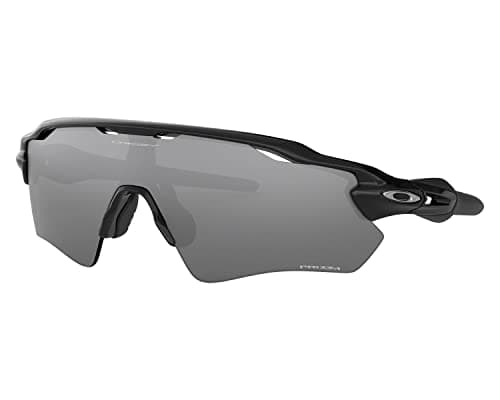
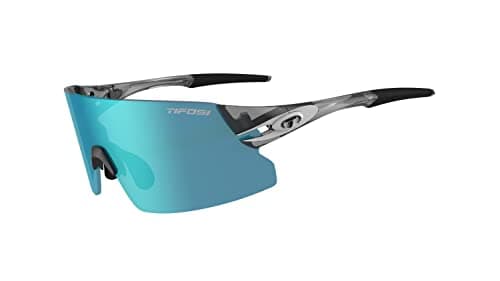
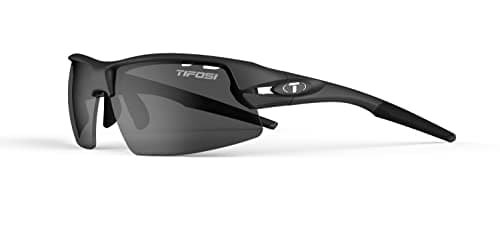
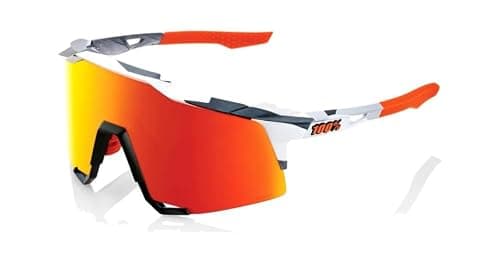
Buy the Tifosi Rail. It gives you a big protective shield and a set of interchangeable lenses for changing light, for a quarter of what the Italian marquee brands charge. If money is no object and you want the best contrast lens on the road, the Oakley Radar EV is the answer — and it is a lot of money.
Cycling is the category with the most counterintuitive advice on this whole site, so we will lead with it: polarized is usually the wrong choice on a bike. A polarized lens dims LCD screens, and the LCD screen you care about is your bike computer — a Garmin or Wahoo washes out under a polarized lens exactly when you glance down at it. Worse, polarization can mask the sheen that warns you of a wet or oily patch on the road, which is a safety cue you do not want removed at speed. This is why almost every dedicated cycling lens — Oakley Prizm Road, most Tifosi and KOO lenses — is deliberately non-polarized. Read that again if you were about to buy a polarized cycling pair; the brands are not cutting a corner, they are making the right call. If you have read that and still want the filter — and there are riders for whom it is the right call — the best polarized cycling sunglasses names the conditions where that decision holds up and ranks the riding frames that genuinely have it.
Coverage and the right lens for the light
What a cyclist actually needs is coverage and the correct lens for the conditions. Coverage because you are moving fast into wind, grit and low sun, often looking up through the top of the lens when you are down in the drops — a tall, wraparound shield keeps all of that out of your eyes in a way a small lifestyle frame cannot. The right lens because cycling light changes constantly: bright open road, dark tree cover, low dawn sun, all in one ride.
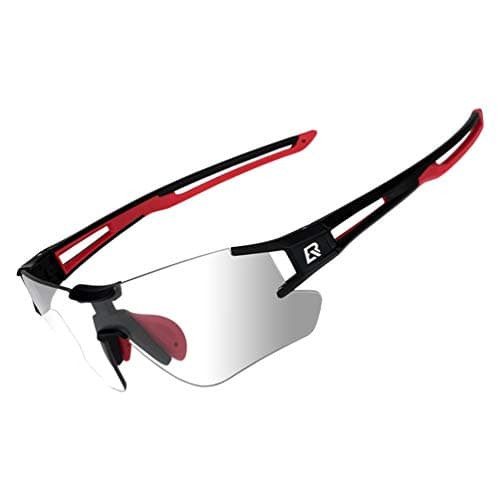
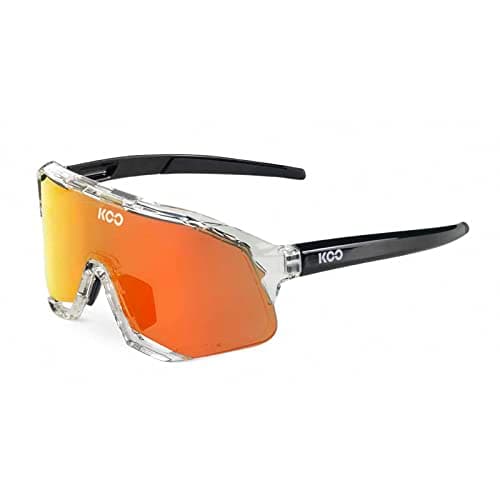
There are two good answers to changing light. The first is interchangeable lenses — the Tifosi Rail ships with several, so you swap for the conditions. The second is a photochromic lens that auto-darkens in bright light and clears in shade, so one lens covers the whole ride with no swapping; the budget ROCKBROS pick does exactly this and is genuinely clever for the money. High end, Oakley's Prizm lens tunes contrast to make road hazards pop earlier, and KOO uses Zeiss glass for reference optical clarity. Both are excellent and both are expensive.
Fit and stability matter more here than in any category except running. A cycling pair has to stay locked on over rough surfaces and through the vibration of a fast descent, which is why the good ones have grippy, adjustable nose pieces and arms designed to work with a helmet's straps. A pair that slips down on a descent is not a minor annoyance — it is a hazard. Every pick here is chosen with that in mind.
How to choose a cycling pair
Skip polarized (mostly)
Polarized dims your bike computer and can mask wet-road sheen. Dedicated cycling lenses are non-polarized on purpose — follow that lead unless you have a specific reason not to.
Prioritize coverage
A tall, wraparound shield keeps wind, grit and low sun out when you are moving fast and looking up from the drops. This is the single biggest reason to buy a cycling-specific frame over a lifestyle one.
Solve changing light: interchangeable or photochromic
Interchangeable lenses (Tifosi Rail) let you match the conditions; a photochromic lens (ROCKBROS) auto-adjusts across a whole ride. Both beat a single fixed tint for a sport where light changes constantly.
Check fit with your helmet
Grippy, adjustable nose pieces and helmet-friendly arms keep the pair locked on over rough surfaces and fast descents. A pair that slips at speed is a safety problem, not a nuisance. Lens height matters here too — a very tall shield can knock against a low helmet brow on rough ground, which is exactly why Tifosi sells a smaller version of its winner. Our Tifosi Rail XC review works through that choice in detail.
More on the brands above
KOO is the least familiar name in these picks and the one readers ask about most — an Italian brand built around Zeiss lenses, assessed in full in our KOO sunglasses review.
How we picked
We don't run a testing lab
We compile each pair's published specifications — lens material, polarization, coating, frame material, coverage, UV rating and price — normalize them, and score each against a published rubric. The scores are judgments from documented research; they are notmeasurements we took, because we don't own a lab and we're not going to pretend we do. Pairs we claim to have lab-tested: 0.