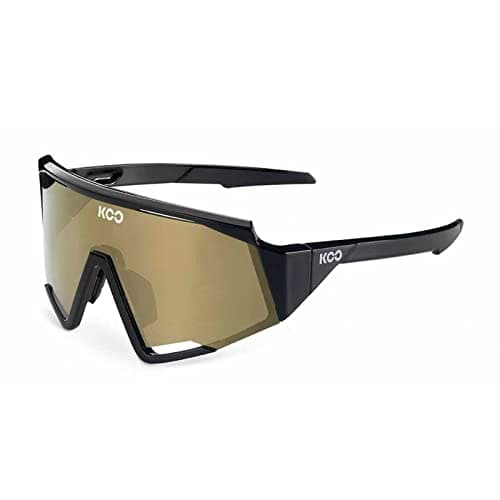
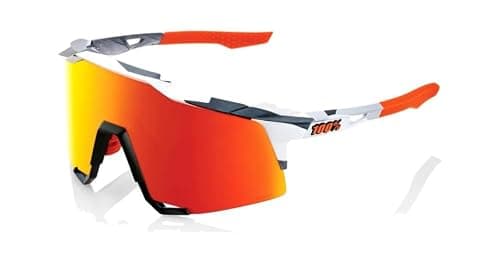
What 100% is
100% came to road cycling from motocross and the design language arrived intact: enormous cylindrical lenses, minimal frame, aggressive angles. For several seasons it was among the most visible eyewear in the professional peloton, which is how most people first encountered it.
Underneath the styling there is a real engineering argument worth separating from the image. A rider on the drops looks up through the top edgeof the lens. If the lens is not tall enough, the top of your field of view is frame — or worse, unshielded sky. A cylindrical shield that wraps and extends upward removes that problem, and that is genuinely what you are paying for.
Field of vision is the actual product
The Speedcraft's lens is tall and wide enough that in a low riding position you are looking through lens wherever you look. Over three hours that is not a small thing: a frame edge drifting in and out of your upper vision is a low-grade irritation you stop noticing and never stop being affected by.
The frame is also very light, and the temple arms are thin where they pass under a helmet strap — the other place sport eyewear goes wrong. A thick arm under a strap becomes a pressure point somewhere around hour two.
Where this stops being an advantage is off the bike. Worn walking around, a lens this size is conspicuous and blocks airflow you would rather have. This is a bike product, and the honest way to buy it is as one.
HiPER lenses
HiPER is 100%'s contrast lens family — a tuned tint plus a mirror coating, in the same category of idea as Prizm and ChromaPop rather than a plain dark lens. On tarmac it makes surface changes register a beat earlier: a patch of fresh asphalt, a damp line under trees, gravel washed across a corner.
We are not going to quantify that. Nobody without a lab can, and we do not have one. What we will say is that a mirrored contrast lens is a genuinely different object from a cheap dark tint, and that the difference shows most in flat light rather than blazing sun — the general argument is in best mirrored sunglasses.
Like most cycling lenses, HiPER lenses are not polarized. That is correct: a polarized lens removes the reflection that tells you a corner is wet and dims a bike computer screen. Full argument in are polarized lenses good for cycling.
Fit, and the honest warning
The Speedcraft fit is aggressive. It sits close to the face, wraps hard, and suits a medium-to-large face with reasonable cheekbone clearance. On a smaller face the lens can touch eyelashes or cheeks; on a very narrow face the frame simply does not sit right. There is a smaller variant in the range, and if you are between sizes that is the one to look at — our sizing guide covers how to tell which side of the line you are on.
Eyelash contact in particular is the complaint that recurs with big cylindrical shields. It is a fit problem rather than a quality problem, and it does not improve with wear.
Where 100% stops
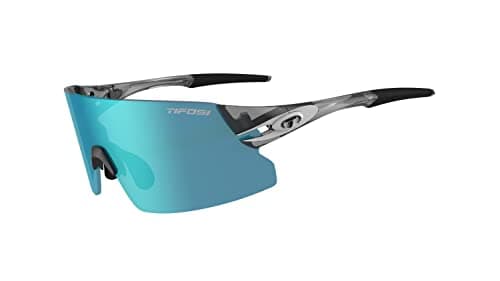
Price against Tifosi.A Tifosi Rail gives you a comparably large shield and three interchangeable lenses for materially less money. It is less refined and the optics are a step below, but for most riders it is the better value decision — the same logic we set out in Oakley vs Tifosi applies here.
One tinted lens in the box, usually.Light changes on a ride. A single fixed tint is wrong for part of most outings, and the two fixes are an interchangeable set or a photochromic lens — see best photochromic sunglasses.
It is a single-purpose object.Not for driving, not for the water, not for everyday. If you want one pair that does everything, this is emphatically the wrong page — try best sunglasses.
Are 100% sunglasses worth it?
For a road or gravel rider who spends real time in a low position, yes: the field of vision is a functional advantage and the frame disappears on your face. For a rider who wants one pair for the bike and everything else, or who is optimizing value rather than performance, no — the tier below does the job. The full field is in our cycling sunglasses roundup.