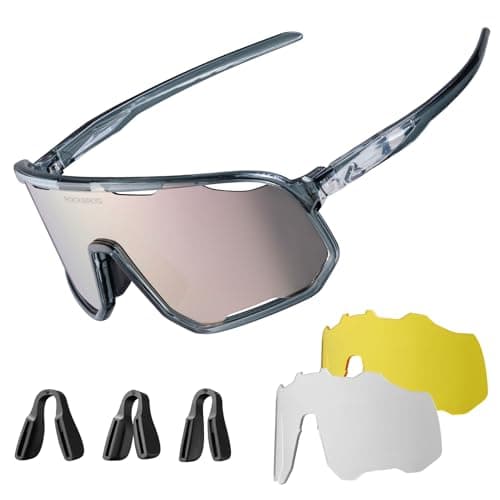
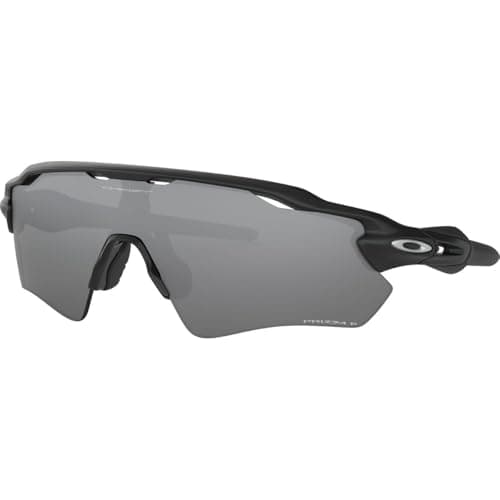
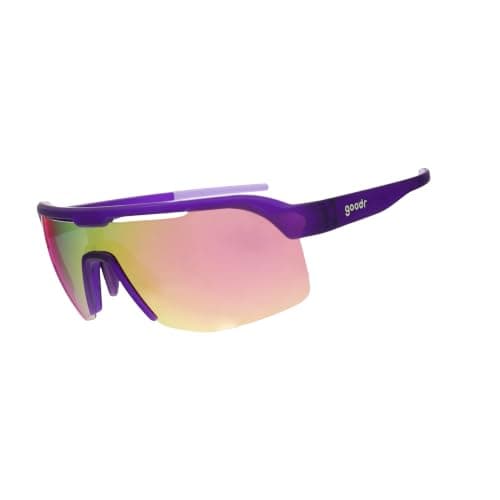
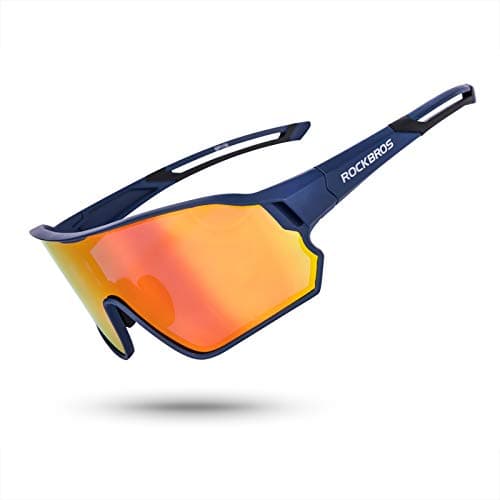
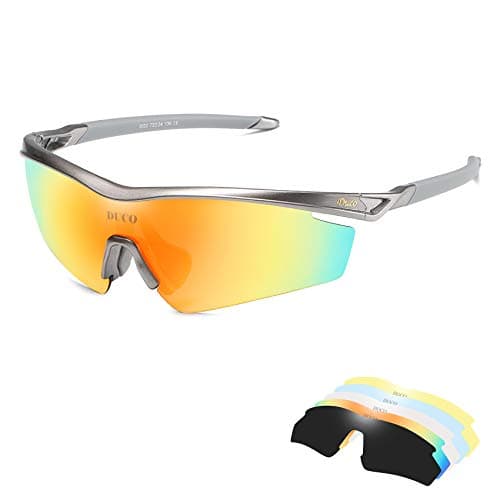
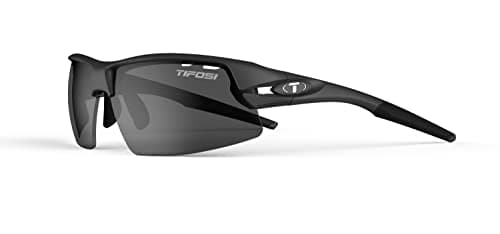
Buy the Tifosi Crit in Smoke Polarized Fototec. It is the only pick here that is polarized andtracks the light, which matters because the real problem with a polarized cycling lens is not the filter — it is that the filter almost always arrives attached to a dark lens. If that is more than you want to spend, the ROCKBROS three-lens set gets you a polarized bright lens plus a yellow and a clear spare for everything else. Buy the Oakley Radar EV Path because you want the frame and the coverage, not because its polarizing filter is better; that part is identical to the one in the cheapest pair on this page.
Before the picks, the honest part. Our cycling sunglasses roundup tells you not to buy polarized for the bike, and our full explainer on polarized lenses for cycling spends a page on why. Both of those still stand. This page is not a retraction of them — it is the follow-through. Plenty of riders arrive here having already decided they want a polarized pair, for reasons that are often perfectly sound, and the useful thing to do is tell them which conditions make that a good decision, which three things they are giving up, and which cycling-capable frames are genuinely polarized rather than just described as "sport."
1. Why almost every cycling lens is non-polarized on purpose
A polarizing filter blocks light traveling on one axis. Light bouncing off a flat surface comes back horizontally aligned, so the filter removes that reflection and leaves the rest of the scene alone — the Cleveland Clinic sets out the mechanism, and the long version is in polarized vs non-polarized. That is a brilliant trick on water. On a bike it collides with three specific things.
Your head unit. Many LCD displays carry a polarizing layer of their own, and when the two filters work against each other the screen dims or blacks out at particular angles. Garmin's own support documentation describes the effect and suggests changing the viewing angle. On a run you turn your wrist. On a bike your head-to-stem angle is fixed by your riding position, so a washed-out computer stays washed out for the whole ride. The wider version of this is in do polarized sunglasses block screens, and All About Vision explains why rotation is the fix.
Wet-road sheen. A damp patch, an oil slick or a diesel spill announces itself as a reflection. Cancel the reflection and a greasy corner can read as dry tarmac until your tires find out otherwise. Most riders would rather keep that warning than gain glare comfort.
Reading drivers.This one gets left out of most write-ups and it is the most interesting of the three. Selle Anatomica's rider resource on the subject points out that a polarized lens reveals the stress pattern in tempered glass, which makes a car's side and rear windows harder to see through — and that seeing through them is how you tell whether a driver at a junction has actually clocked you. Its coaching source is blunt about the priority: the place to look is the driver's head, to see where the head and eyes are pointed. If you ride in traffic, weigh that one heavily.
2. So who should actually buy polarized for riding?
The three problems above are conditional, not universal, and if none of them describes your riding then the case against polarized mostly evaporates. Buy polarized for the bike if you recognize yourself here:
- You do not ride with a head unit. No Garmin, no Wahoo, phone stays in the jersey pocket. The single biggest objection simply does not apply to you.
- Your riding is bright, open and mostly traffic-free.Canal towpaths, seafront and rail-trail bike paths, long flat roads in reliably good weather. Lots of glare off pavement and water, few junctions where you need to read a driver's eyes.
- You ride dry, dusty, high-glare terrain. Desert and hardpack gravel throws a lot of flat reflected light and very little of the wet sheen the filter would hide.
- You want one pair for the bike and the rest of your life. If the same glasses do a commute, a drive and an afternoon on the water, polarized wins on the other two uses by a distance. Our polarized sunglasses roundup is the wider field for that job.
- Glare genuinely bothers you more than screen legibility does. This is a real preference and not a mistake. Some riders find low sun off wet tarmac actively painful and would trade a dim computer for it every time.
And the honest inverse: if you race, ride in city traffic, ride technical singletrack, or check a power number every thirty seconds, buy a non-polarized contrast lens instead. The cycling hub ranks that field, and the mountain bike guide covers dappled trail light, where polarization is at its least helpful.
3. The field genuinely disagrees, and here is the fault line
It is worth knowing that this is not settled. Cycling brands overwhelmingly build non-polarized road lenses. Polarized-lens brands argue the opposite: Maui Jim's own cycling guide states that for road cyclists "polarized is almost always the better call," on the grounds that it cuts pavement and traffic glare without distorting distance or color. The same guide is more cautious about mountain biking, noting that some riders find polarization dulls the subtle light and shadow cues that reveal loose rock, roots and elevation changes on technical trail.
Both camps are describing the same physics and weighting the outcomes differently. The fault line is almost entirely whether you have a screen to read and traffic to negotiate. A rider with neither is choosing between glare comfort and a wet-road cue. A rider with both is choosing between glare comfort and two safety inputs, which is a very different trade. Decide which of those two riders you are before you decide which lens to buy.
4. The mistake almost nobody avoids: polarized is not the same as dark
Polarization and tint are separate properties that happen to ship together. Manufacturers put the filter in their dark bright-sun lenses because that is the lens people buy for glare, so in practice "polarized cycling lens" nearly always means "dark cycling lens" too. That is what ruins polarized pairs for riders: the lens is fine at noon in July and useless at 6am in October, and a ride that starts in the dark is the most common ride there is.
There are only two real answers, and they set the ranking on this page. Either the lens adapts — a polarized photochromic like the Tifosi Crit, which Tifosi lists as a Smoke Polarized Fototec option on its own product page — or the box contains other lenses, which is what the ROCKBROS and DUCO kits are for. A single fixed dark polarized lens is the one configuration to avoid unless every ride you do is in bright sun. Getting this wrong is the reason so many riders conclude polarized "does not work for cycling" when the actual problem was the tint.
One caveat on kits, and it is a real one: interchangeable sets typically put the polarizing filter in the dark lens only, and ship the yellow and clear spares as plain tinted polycarbonate. That is fine — the spares are for light you do not need a filter in — but do not assume the whole set is polarized. Check the lens the listing actually describes as polarized. The lens-tint logic itself is in sunglasses lens colors explained.
5. What has to be true regardless of the filter
Polarization is the last decision, not the first. A polarized lens in a frame that does not suit a bike is worse than a non-polarized lens in one that does, so everything below applies before the filter is even on the table.
Coverage. You ride fast into wind, grit, bugs and low sun, and when you are down on the drops or the bar tops you look up through the top of the lens. A tall wraparound is the shape that still protects you in that position; the same cycling guide makes the point that a wraparound blocks wind, bugs and peripheral glare in a way a standard frame cannot.
Grip, and helmet compatibility. Rubberized nose and temple pads that hold under sweat are not optional on a bike, because vibration and sweat are constant and a frame that creeps down your nose on a climb is a hazard on the descent that follows. Arms have to route cleanly under helmet straps too. ROCKBROS publishes its polarized cycling frame at 26g in TR93 memory polymer with non-slip nose pads and soft rubber ear frames, which is the right shape of spec sheet for the job; Tifosi lists fully adjustable hydrophilic rubber arm and nose pieces on the Crit that tighten as you sweat.
Venting. Climbs are where fogging happens, because that is where airflow drops and heat output peaks. Vented lenses and a frame that stands slightly off the face are the fix; Oberson's guide to running and cycling eyewear covers both that and the lens-category question — category 2 at roughly 18–43% light transmission for variable conditions, category 3 at 8–18% for bright sun.
UV400, which is not the same thing at all. The American Optometric Association recommends lenses blocking 100% of UVA and UVB, and a $20 UV400 lens does that exactly as well as a $300 one. Polarized and UV-protective are unrelated properties that share a listing. Full detail in UV protection explained.
How we ranked these
Confirmed polarization was the entry requirement, not a ranking factor: every frame here is published as polarized by the brand that makes it, and anything we could not confirm was left off. After that the order is — how well the pair copes with light that is not bright noon sun, then cycling-grade coverage and stability with a helmet, then optics and build, then price. That ordering is deliberate and it is why a sub-$30 kit outranks a frame costing ten times as much: on a bike, the dark-lens problem is the one that actually ruins rides, and a spare lens solves it more completely than better glass does. Scores come from the rubric on how we rate— judgments compiled from published specifications and documented research, not lab measurements. We do not run a lab.
Buying a polarized pair for the bike
1. Settle the head-unit question first
If you ride to a screen, stop here and buy non-polarized. Nothing further down this list fixes a computer you cannot read in your normal riding position, and no amount of glare comfort is worth squinting at a navigation prompt in traffic.
2. Confirm it is actually polarized — and which lens is
"Sport," "HD," "mirrored" and "UV400" do not mean polarized, and several cycling brands leave their sport lenses unpolarized deliberately. On an interchangeable set, find the one lens the listing describes as polarized rather than assuming the whole box is. How to tell if sunglasses are polarized has the two-second test for a pair already in your hands.
3. Buy a way out of the dark lens
A photochromic polarized lens or a set with clear and yellow spares. A single fixed dark polarized lens only works if every ride you do is in bright sun, and almost nobody's riding is.
4. Coverage, grip and helmet fit come before optics
A tall wrap, rubberized nose and temple pads that tack up as you sweat, arms that sit properly under your helmet straps, and vents at the top of the lens. Try the frame on with the helmet you actually ride in — a very tall shield can contact a low brow on rough ground.
5. Do not pay extra for the filter itself
Polarization is binary and identical at every price, exactly like UV400. What more money buys is the frame, the lens geometry, the coatings and the warranty. Pay for those or do not pay at all; both are defensible on eyewear that lives on a bike.