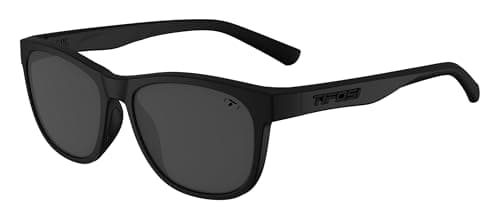
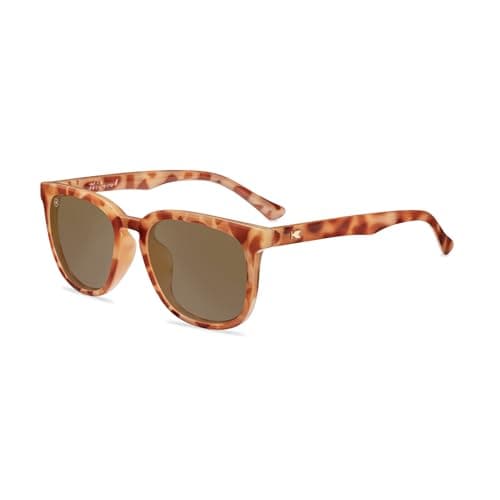
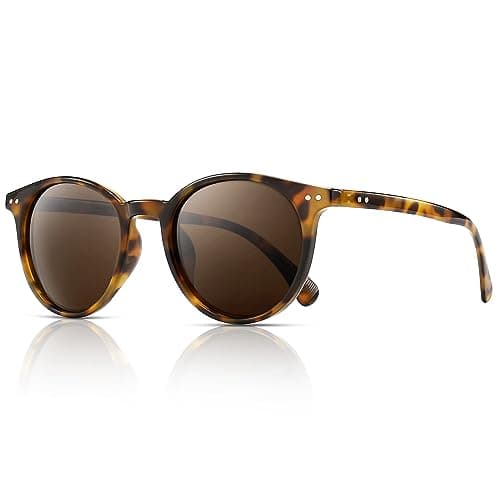
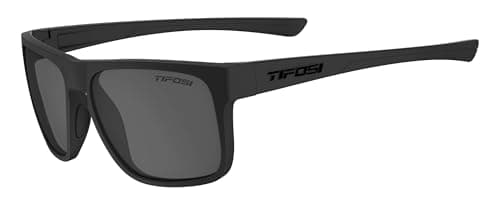
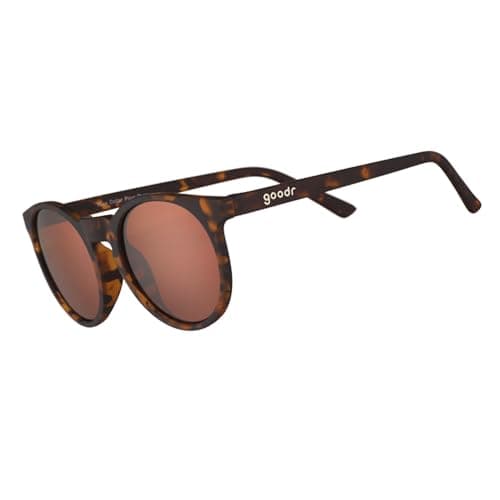
Shop by total frame width, not by style. If frames slide down your nose or the lenses touch your cheeks, you want something around 130 mm wide or less — roughly a 48-52 mm lens. The goodr Circle G is the easiest recommendation because it is a genuinely small frame with a grip coating that stops the sliding entirely; the Tifosi Swank is the sport-capable version at the same scale.
Small-face buying advice usually arrives as a list of styles, which is close to useless, because every one of those styles is also made in sizes that will not fit you. Width is the variable. Once you know your number, the shape question becomes easy and mostly a matter of taste.
1. The number to shop by
Total frame width is the outside of one hinge to the other. Standard adult sunglasses sit around 135-145 mm. A small or narrow face generally wants 125-133 mm, which usually corresponds to a lens width of about 48-52 mm.
Those three numbers stamped inside the temple arm — lens width, bridge width, temple length — are the fastest way to shop online, and how to choose sunglasses size explains how to read them. Once you know that 50-19-140 fits you and 58-17-145 does not, you can filter a whole catalog in seconds.
Quick check in a mirror: the hinges should sit at the outer edge of your face. If the frame extends noticeably past it, it is too wide, and everything below follows from that.
2. Sliding is usually a width problem, not a grip problem
This is the most common misdiagnosis on the internet. People whose sunglasses slide buy grip pads, tighten the arms and try sport frames, when the actual cause is that the frame is wider than their face and therefore not being held at the temples at all. All the weight lands on the nose, and a nose is a slope.
A correctly sized frame is supported at three points — bridge and both temples — and barely moves. If yours is only touching your nose and your ears, it is too wide. Grip material helps a well-fitting frame stay put through sweat; it cannot make an oversized frame fit. The whole diagnostic is in how to stop sunglasses slipping.
3. Bridge width matters more than you would think
A narrow face often comes with a lower or narrower nose bridge, and a frame with too wide a bridge rests low no matter how well the width fits. Look for a bridge of 16-18 mm rather than 19-22 mm, or buy a metal frame with adjustable nose pads and set it yourself.
Frames described as an "Asian fit" or "low bridge fit" are engineered specifically for this — higher nose pads and a shallower bridge angle — and they are worth looking at regardless of who you are, because the geometry is the point rather than the label.
4. Lens height and cheek contact
The second symptom of an oversized frame is the lens bottom touching your cheeks, which smears the lens every time you smile and traps warm air against it so it fogs. Look for a shallower lens height as well as a narrower width — small round and small rectangle shapes tend to be shallower than the current oversized square trend.
Big cylindrical sport shields are the worst offenders here, and it is worth knowing before you buy one. We flag the same issue on the premium cycling frames in the 100% review.
5. Sport frames for small faces genuinely exist
If you run or ride, you do not have to accept a frame that bounces. Several sport brands publish a standard and an XL version of the same frame, and the standard one is often genuinely small. Tifosi's Swank and Swick are the clearest example on this site — the XL exists because the standard is not large.
For running specifically, the combination you want is a small frame plus hydrophilic grip, which is exactly what the goodr Circle G and the Tifosi Swank deliver. The whole running field is in the running sunglasses roundup.
6. Kids' frames: mostly a bad idea
A common suggestion for very small faces is to buy children's sunglasses. Occasionally that works, but the temple length is usually far too short for an adult head, which produces the behind-the-ear pressure marks that a too-narrow frame causes. Check the temple length before considering it; anything under 130 mm is likely to be uncomfortable.
How we ranked these
Frame width first, bridge and lens height second, grip third, price fourth. Every pick is polarized and UV400 — the American Optometric Association recommends blocking 100% of UVA and UVB, and that protection costs almost nothing. Scores come from the rubric on how we rate; they are judgments compiled from published specifications, not lab measurements. We do not run a lab.
Buying for a small face
1. Target 125-133 mm total width
Roughly a 48-52 mm lens. Anything at 140 mm or above will sit wide and slide.
2. Check the bridge separately
16-18 mm, or adjustable nose pads. A wide bridge drops the frame down your nose regardless of width.
3. Watch lens height, not just width
If the lens bottom touches your cheek it will smear and fog. Shallower shapes solve it.
4. Fix sliding with size first, grip second
Grip coatings hold a well-fitting frame through sweat. They cannot hold an oversized one at all.
5. Check temple length before buying kids' frames
Usually too short for an adult head, which just moves the pressure point behind your ears.