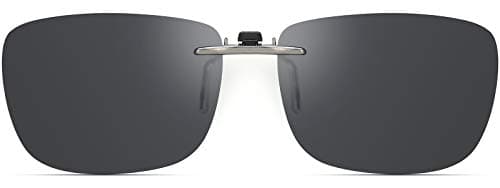
You do not need to buy prescription sunglasses to get polarized vision. A polarized clip-on costs less than a takeaway and attaches to the glasses you already own. A fit-over gives more coverage for a little more bulk. And if your use is sport, a frame with a prescription insert behind a wraparound lens is the option almost nobody mentions and is often the best of the three.
"Sunglasses with prescription" is one of the highest-volume searches in this whole category, and the results are dominated by optical retailers selling you a full second pair of glasses with a tint. That is a legitimate product and it is also, for most people, an overpriced answer to a small problem. What most glasses wearers actually want is glare control on bright days without spending a few hundred dollars and without carrying a second pair everywhere. There are three ways to get that, and this page is about choosing between them honestly.
A quick note on what we can and cannot help with. Anything requiring your actual prescription — lens grinding, high-index lenses, progressive or bifocal sun lenses, or a strong or unusual prescription — is optician territory, and we are not opticians. What we can do is compare the non-prescription hardware that sits in front of, over, or behind the glasses you already have.
Route 1: the polarized clip-on
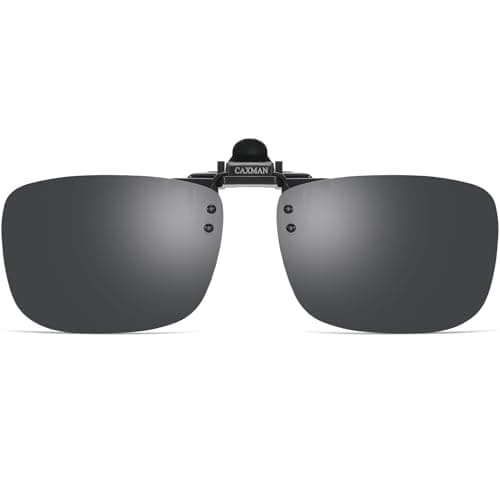
The cheapest and most discreet answer. A polarized clip attaches to your prescription lenses with small padded grips or a bridge clip, adds real polarized glare control, and comes off and folds into a pocket when you go inside. For a driver who moves between sun and shade constantly, the flip-up version is better still — the lens hinges up out of your line of sight instead of coming off entirely.
The trade-offs are honest and specific. Clip-ons only fit a limited range of lens shapes and sizes, so check the published dimensions against your own lenses; rimless and unusually shaped lenses are where they most often fail. The clip contacts your prescription lenses, so grit trapped on the pads can scratch a soft anti-reflective coating over time — keep both surfaces clean, which our cleaning guide covers. And there is no side coverage at all, so light still reaches the inside of your lenses from the sides.
Route 2: the fit-over
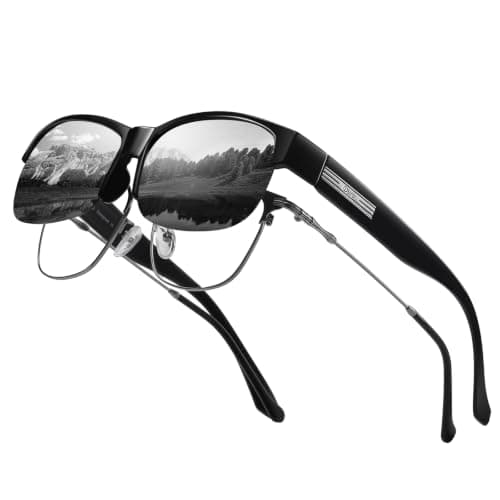
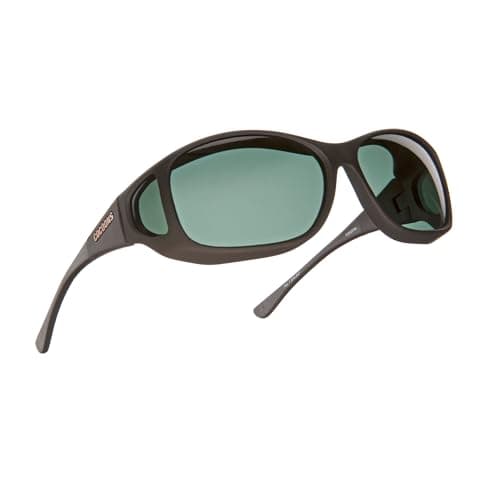
A complete sunglass that goes over your glasses, with tinted side panels that block the light a clip-on lets in. This is the better choice if you spend real time outdoors, on the water, or driving in strong low sun, because that side light is what causes the washed-out veiling reflection on the inside of prescription lenses.
The costs are bulk and fogging. A fit-over sits further from your face and creates a pocket of warm air with two lens surfaces in it, so it fogs more readily than anything else here. And it is visibly a fit-over from the side, however well designed. The premium end of the category solves a surprising amount of this with a closer-fitting cavity and multiple sizes. We go through the measuring process and the full field in our fit-over guide, answer the does-it-really-work question in do fit-over sunglasses work, and rank them for the hardest use of all in best fit-over sunglasses for fishing.
Route 3: the sport frame with a prescription insert
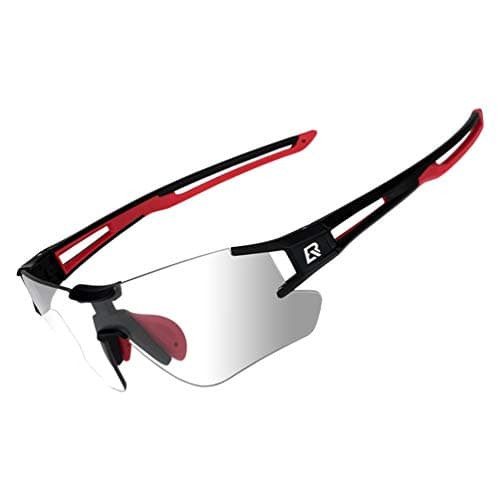
This is the option that gets overlooked, and for an active glasses wearer it is frequently the best one. A number of sport frames ship with — or accept — a small wire insert that sits behind the main lens and holds two prescription lenses, which your optician glazes far more cheaply than a full pair of prescription sunglasses. You get a proper wraparound sport lens with full coverage, correct vision, and no clip touching anything. The ROCKBROS photochromic above includes exactly this kind of insert.
The catch is that an insert sits close to your eyes and can fog on a hard effort, the optical quality depends on how well the insert is centered for your pupils, and you still need an optician to glaze it. But for cycling, running or anything where a clip-on would fall off and a fit-over would fog, it is the serious answer.
Route 4: actual prescription sunglasses
Worth it when sunglasses are on your face for hours every day, when your prescription is strong enough that peering through a second lens surface degrades your vision noticeably, or when you simply want a pair that looks like sunglasses and nothing else. Buy them from an optician who can confirm the lens is genuinely polarized and UV-blocking; the American Optometric Association recommends 100% UVA and UVB blocking regardless of the tint or the price.
One point that applies to all four routes: polarization and UV protection are separate specs, and a lens can have either without the other. A dark tint with no UV filter is genuinely worse than no sunglasses at all, because it opens your pupils while letting UV through. Confirm both.
A caveat for cyclists and anyone reading a screen
Polarized lenses dim LCD screens, which includes bike computers, boat chartplotters and car displays. If your outdoor time involves staring at one of those, a photochromic or plain tinted lens may serve you better than a polarized one — and the ROCKBROS above is photochromic rather than polarized for exactly that reason. Our are polarized lenses good for cycling guide covers the argument properly.
Which route is yours?
Occasional sun, want it in a pocket
Clip-on. Cheapest, most discreet, and the flip-up version is excellent for driving in and out of shade.
Regular outdoor time, driving, water
Fit-over. The side panels are what a clip-on cannot give you, and they solve the washed-out veiling reflection on the inside of your lenses.
Sport, sweat, movement
A sport frame with a prescription insert. Full coverage, nothing to fall off, and cheaper to glaze than full prescription sunglasses.
All day, every day, strong prescription
Actual prescription sunglasses, bought from an optician who will confirm UV400 and polarization.
Start with the cheapest option first
Before committing to a second prescription, it is worth spending a few dollars to find out how often you would actually wear it. A polarized clip-on costs a fraction of a prescription lens and answers that question in a week — best clip-on sunglasses ranks the clips and the fit-over alternatives, including the flip-up design that is the best answer for drivers.