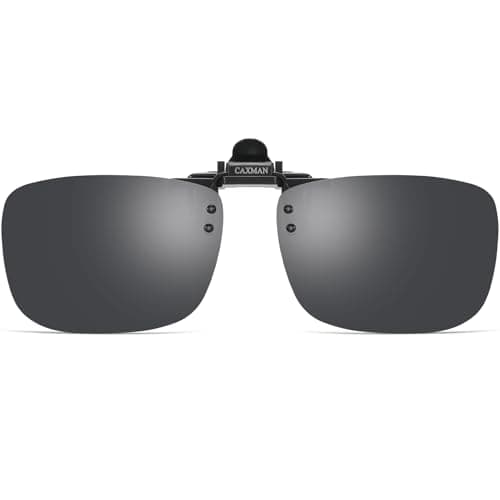
The flip-up clip is the pick for most glasses wearers, and especially for drivers: it clamps to your own frame, costs around the price of a sandwich, and flips the lens up out of the way when you enter a tunnel or want to read a screen. Buy the fixed clip-on instead if you want the lowest profile and do not need to remove the filter mid-journey. If your frames are thick, deeply curved, rimless or unusually large, a clip will not sit right and a fit-over is the correct answer — three are ranked below for exactly that case.
Prescription glasses wearers have four options for sun: a second pair of prescription sunglasses (the best result and by far the most expensive), photochromic lenses in your everyday glasses (convenient, but slow and weak behind a windshield), a fit-over that goes on top of your glasses, or a clip-on. This page is about the last one, which is the cheapest and the most under-rated. The full comparison of all four routes is in prescription polarized sunglasses, and the fit-over field is ranked in sunglasses that fit over glasses.
What to look for in a clip-on
Polarized, not just tinted. This is the whole reason to buy one. A tinted clip makes things dimmer; a polarized clip removes the sheet of reflected glare off wet road, water and car hoods, which is the thing you actually want gone. The Cleveland Clinic describes that mechanism and notes how useful it is while driving. Check the listing says polarized explicitly.
Flip-up or fixed.A flip-up hinges at the bridge so the lenses rotate up onto your forehead; a fixed clip has to come off entirely. If your light changes — commuting, driving in and out of tree lines, moving between a yard and a workshop — the flip-up wins on convenience alone. If you put sunglasses on in the morning and take them off at night, the fixed clip is lighter and less conspicuous.
How it attaches, and to what.Most clips grip the top rim of the lens with sprung arms. That works on standard plastic and metal full-rim frames of normal thickness. It works badly on very thick acetate, on strongly curved wrap frames, on semi-rimless frames with no top bar to grab, and on rimless frames where there is nothing structural to clamp. Measure your lens width before buying and compare it against the clip's stated size — a clip narrower than your lens leaves a bright strip at the outer edge, which is more annoying than no clip at all.
Weight on your nose. You are adding mass to a frame that was balanced without it. Light clips are better. If your glasses already slide down, a clip makes it worse; see how to stop sunglasses slipping for the nose-pad and grip fixes.
Scratch risk, which nobody warns you about. A clip sits directly against your prescription lenses. Grit trapped between the two surfaces is the single most common way people scratch expensive lenses with a cheap accessory. Keep the clip in a pouch, not loose in a pocket, and read how to clean sunglasses before you dry-wipe anything.
What a clip-on cannot do
Three honest limits. It gives you no coverage at the sides, so light arrives around the edges in a way it would not with a wrap or a fit-over with side shields. It cannot match the optical quality of a ground prescription sunglass lens. And a custom-cut clip made by an optician to match your exact frame shape — usually magnetic — is a better product than anything on this page; we do not have one in our catalog, and if your frames are unusual that is the route to ask your optician about rather than buying a universal clip and hoping.
The short answer
Quick picks
#ad · Live prices from the Amazon Product API, as of October 19, 2026. Where we have no verified live price, we show none — we would rather leave a gap than print a number that has rotted.
In detail
The picks, in full
Drivers and anyone in and out of shade
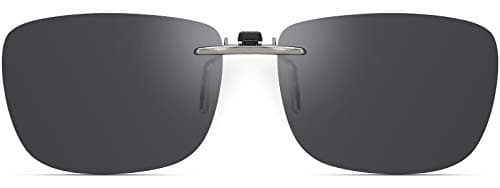
CAXMAN Flip-Up Clip-On (Rimless)
Flip-up clipPolarizedRimless lensMetal clip
A flip-up clip for people who move in and out of sun constantly and hate taking things off.
- Glare control
- 8
- Optics
- 6
- Fit & coverage
- 6
- Durability
- 5
- Value
- 10
Pros
- +Flipping the lens up beats removing and pocketing a clip every time you go inside or under trees
- +Rimless construction keeps the weight down on the bridge of your nose
- +Cheapest way to add polarization to glasses you already own
Cons
- −The flip hinge is the moving part, and moving parts at this price are the first thing to loosen
- −The clip's metal contact points can mark a soft lens coating if grit gets in
Don't buy this if…
…you want the most secure fit. A fixed clip or a fit-over stays put better than a hinge; the flip-up trades a little security for a lot of convenience.
Keeping your own frames and adding glare control
CAXMAN Polarized Clip-On
Clip-onPolarizedCompact fitLightweight
The compact clip-on answer — polarized shade without a second pair of glasses on your face.
- Glare control
- 8
- Optics
- 6
- Fit & coverage
- 6
- Durability
- 6
- Value
- 10
Pros
- +Adds real polarized glare control to the prescription frames you already like wearing
- +Far less bulky than a fit-over, and it disappears into a pocket when you go indoors
- +Costs a fraction of prescription sunglasses
Cons
- −Clip-ons only fit a limited range of lens shapes and sizes — check yours against the listed dimensions
- −The clip contacts your prescription lenses, so grit on the pads can scratch them over time
Don't buy this if…
…you have rimless or unusually shaped prescription lenses. Clips need a predictable lens edge to grip, and an odd shape is where clip-ons fail.
Best fit-over for most prescription wearers
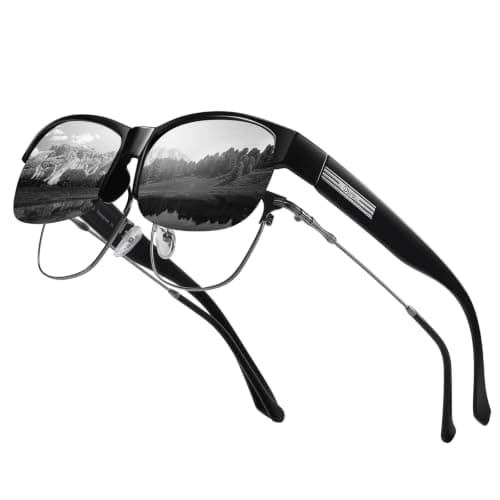
DUCO HD Polarized Fit Over (8960)
Fits over glassesPolarizedUV400Side shields
The fit-over to buy first — genuinely polarized, properly sized, and not embarrassing to wear.
- Glare control
- 8
- Optics
- 7
- Fit & coverage
- 7
- Durability
- 7
- Value
- 9
Pros
- +Genuinely polarized rather than merely tinted, which is not a given in the fit-over aisle
- +The frame is cut close enough to the face that it reads as sunglasses rather than as safety goggles
- +Wraparound side panels block the light that leaks in around a standard pair worn over specs
Cons
- −Like every fit-over, it sits further from your face than normal sunglasses, so it can fog in humidity
- −Only fits frames up to its published interior dimensions — measure your glasses first
Don't buy this if…
…your prescription frames are oversized. Fit-overs have a fixed interior cavity, and a large frame simply will not go in — measure the width and height of your glasses before ordering.
Smaller frames and a less bulky look
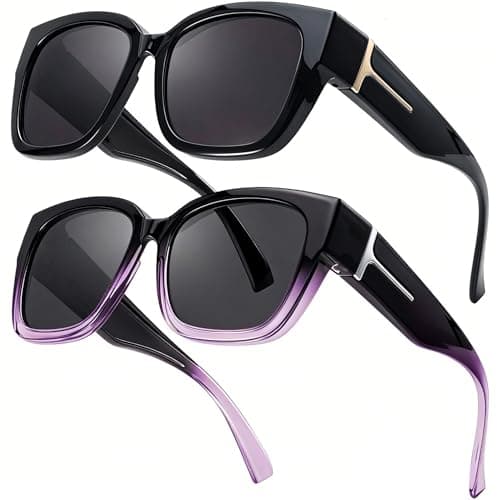
LVIOE Polarized Fit Over
Fits over glassesPolarizedUV400Lighter profile
A softer, less clinical-looking fit-over that suits smaller prescription frames.
- Glare control
- 8
- Optics
- 6
- Fit & coverage
- 7
- Durability
- 6
- Value
- 9
Pros
- +A slimmer, more styled shape than the typical fit-over slab — the main complaint people have with this category
- +Polarized and UV400, so the glare and UV fundamentals are covered
- +Light enough that it does not add much weight on top of the glasses already on your face
Cons
- −The smaller cavity that makes it look better also means it fits fewer prescription frames
- −Budget coatings; expect scratches sooner than a premium lens
Don't buy this if…
…you wear medium or large prescription frames. The slimmer profile is the whole appeal here, and it comes directly out of the interior space.
The fit-over you keep for years
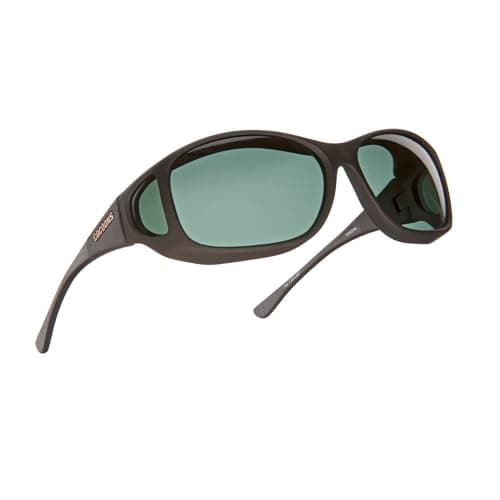
Cocoons Style Line (Polarized)
Fit-over (OveRx) designPolarizedSide shieldsMultiple frame sizes
The premium end of the fit-over category — better optics and a proper build, at a real price.
- Glare control
- 9
- Optics
- 8
- Fit & coverage
- 8
- Durability
- 8
- Value
- 6
Pros
- +Cocoons builds fit-over eyewear as its core product line rather than as an afterthought, and the fit engineering shows
- +Polarized lens quality is a clear step above the sub-$25 fit-over field
- +Offered in several sizes, which is the single most useful thing a fit-over brand can do
Cons
- −Costs several times what a budget fit-over costs, which is a lot for a category most people treat as disposable
- −Still unmistakably a fit-over from the side — no fit-over solves that
Don't buy this if…
…you only need sunglasses over your specs a few times a year. The budget fit-overs do the same job well enough for occasional use, and this premium only pays back with regular wear.
Who each pick is for
- CAXMAN flip-up clip-on (rimless)— for drivers and anyone whose light changes through the day; flip the filter away and your dash screen comes back.
- CAXMAN fixed polarized clip-on— for a compact, low-profile clip on standard full-rim frames.
- DUCO HD polarized fit-over— for frames a clip cannot grip, and for anyone who wants side coverage as well as a filter.
- LVIOE polarized fit-over— for smaller prescription frames, where the standard fit-over looks and feels oversized.
- Cocoons Style Line— for the reader who wants a fit-over that lasts years and comes in sized options rather than one-size-fits-most.
Clip-on vs fit-over, decided quickly
| Factor | Clip-on | Fit-over |
|---|
| Cost | The cheapest route there is | Modestly more |
| Fits what | Standard full-rim plastic and metal frames | Almost anything, including large and rimless |
| Side coverage | None | Side shields or wrapped sides |
| Removing the filter | Instant on a flip-up | Take the whole thing off |
| Looks | Barely noticeable when well matched | Visibly a second pair of glasses |
| Risk to your lenses | Real — it touches them | Low — it surrounds them |
| Best for | Drivers, changing light, discretion | Big frames, bright open conditions, all-day wear |
If that table leaves you leaning the other way, the honest case for the fit-over route — including the three reasons people give up on them and the fix for each — is in do fit-over sunglasses work.
The driving case is the strongest one
If you drive in glasses, a flip-up clip is close to the ideal product, and for a reason specific to cars. Polarized lenses dim LCD screens, so a dash display or a phone mount can wash out exactly when you need it; with a flip-up you lift the filter for a second and the screen comes back. No other option on the list does that. The same trick covers tunnels, parking garages and the moment the sun drops behind a hill. The wider driving advice is in best sunglasses for driving and best sunglasses for driving into the sun; if you want more coverage than a clip gives you, the fit-over version of this argument is best fit-over sunglasses for driving.
Fitting a clip without damaging anything
Clean both surfaces first — the clip and your lenses — with a proper cloth, because anything gritty between them is what causes scratches. Open the sprung arms wide and lower the clip onto the top rim rather than pushing it on from the front; pushing is how lenses get pressed and frames get bent. Check that the clip's lower edge clears your lower rim and does not rest on the lens surface. If it rocks, it is the wrong size, and no amount of adjusting will fix that.
The honest ranking logic
We rank the flip-up first because the ability to remove the filter in a second is worth more than any other difference between these products, and because it is the cheapest item on the page. The fixed clip is second because it does the same optical job with less bulk. The three fit-overs follow in order of how many frames they will accommodate, with the Cocoons last on price and first on longevity — it is the one you keep. No pair on this page has been lab tested by us, and none carries a rating we invented; the scores come from the published rubric on how we rate.
How to choose in 30 seconds
Do you drive, or move in and out of shade?
Buy the flip-up. The ability to lift the filter is the feature.
Are your frames thick, rimless, semi-rimless or wrapped?
Skip clips entirely and buy a fit-over; a universal clip will not sit correctly.
Do you know your lens width?
Measure it before you order. A clip narrower than your lens leaves an unfiltered strip at the outside edge.
Are your prescription lenses expensive?
Then be deliberate about the pouch and the cleaning cloth. A $13 clip can scratch a $400 lens.
Do you want side coverage?
Only the fit-overs give you that. A clip leaves the sides completely open.
The cheap stuff that matters
Essentials under $40
The add-ons this page already told you to get. None of these is scored — our rubric measures glare control, optics, fit, durability and value, and four of those mean nothing for a cleaning cloth. So you get a reason and a live price instead of a number we'd have had to invent.
MagicFiber
MagicFiber Microfiber Cleaning Cloths (6-pack)
Buy a multipack for one reason: a dirty microfiber cloth is sandpaper. Six means you can retire the gritty one instead of rubbing it across a lens.
Koala
Koala Eyeglass Lens Cleaner Spray Kit (4-piece)
A lens-safe spray for when there is no tap. Sold specifically for coated lenses, which is the point — it is the household glass cleaners that attack coatings.
MyEyeglassCase
MyEyeglassCase Extra Large EVA Zip Hard Case
Sized for large and wrap frames, which is the catch with most cheap cases — a sport frame will not close in a case cut for slim readers.
#ad · Live prices as of October 19, 2026, hidden when our data goes stale. We may earn a commission, at no cost to you. How this works.
How we picked
We don't run a testing lab
We compile each pair's published specifications — lens material, polarization, coating, frame material, coverage, UV rating and price — normalize them, and score each against a published rubric. The scores are judgments from documented research; they are notmeasurements we took, because we don't own a lab and we're not going to pretend we do. Pairs we claim to have lab-tested: 0.
Questions
Frequently asked
Do clip-on sunglasses work on all glasses?+
No. They work well on standard full-rim plastic and metal frames of normal thickness and a matching lens width. They fit badly or not at all on very thick acetate, strongly curved wrap frames, semi-rimless frames with no top bar, and rimless frames with nothing to clamp. For those, buy a fit-over or ask an optician about a custom magnetic clip cut to your frame shape.
Are clip-on sunglasses bad for your glasses?+
They can be, in one specific way: the clip rests against your prescription lenses, so grit caught between the two surfaces will scratch them. That is a handling problem rather than a design flaw. Keep the clip in a pouch, clean both surfaces before fitting, and lower the clip onto the rim rather than pressing it on. See
how to clean sunglasses.
Are clip-ons polarized?+
Some are and many are not — plenty of cheap clips are simply tinted. Polarization is the only reason worth buying one, so check the listing states it explicitly. Both clips we rank here are polarized models. If you want to verify a pair you already own, the test is in
how to tell if sunglasses are polarized.
Clip-on or prescription sunglasses — which should I buy?+
A second pair of prescription sunglasses gives the best optics and the best looks, and costs an order of magnitude more. A clip-on gives you perhaps 80% of the practical benefit for roughly 2% of the price. Our advice: start with a clip, and if you find yourself wearing it every day, that is the evidence you need to justify the prescription pair. Full comparison in
prescription polarized sunglasses.
Will a clip-on give me UV protection?+
A UV400-rated clip blocks UV across the area it covers, but it leaves the sides open, so you get less total protection than a wraparound or a fit-over with side shields. Note also that many modern prescription lenses already include UV blocking. The
American Academy of Ophthalmology recommends looking for 100% UV or UV400 labeling, and is clear that polarization on its own is not UV protection.
Can I wear a clip-on for sport?+
Not seriously. A clip adds weight to a frame that will already slide when you sweat, and an impact pushes the clip into your prescription lenses. For running, cycling or any ball sport, prescription sport frames or contact lenses plus a proper sport wrap are the right answers.
Receipts
Sources
We do not run a testing lab, and we do not pretend to. Where a spec or measurement came from a manufacturer or a third party, we name and link it. Where we could not verify something, we say so on the page rather than quietly leaving it out. Read our full method.