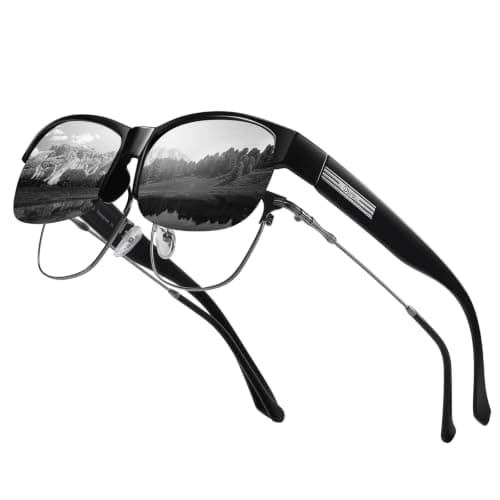
For most drivers who wear glasses, the DUCO polarized fit-over is the buy — polarized, UV400, cheap, and it cuts the sheet of glare off a wet road that a plain tint only dims. But read the flip-up argument before you order: if your drive involves tunnels, tree shade, underground parking or a late-afternoon commute, the CAXMAN flip-up clip-on solves a problem no fit-over can, because you can get the dark lens out of the way in half a second without taking anything off your face. The Cocoons Style Line is the pair to buy if you want one you keep.
Driving is where a lot of people first go looking for a fit-over, and it is also the use with the most real caveats. Three of them change what you should buy, and none of them appears on the packaging.
The three things that make driving different
1. You need your peripheral vision. Mirror checks, blind-spot glances, a kid on a bike at a junction. On the water, side shields are an advantage because they block stray light; in a car they can crop the edge of your vision and sit exactly where you look when you turn your head. This is the one place on this site where we rank less coverage higher, and it is why the heaviest-shielded fit-overs are not at the top of this page.
2. Your dashboard may be an LCD, and your windshield may have a head-up display. A polarizing filter removes light vibrating in one plane, and that is exactly how many LCD panels and HUD projections emit. The result is a screen that dims or blacks out at certain head angles. It is car-specific rather than universal — plenty of drivers never see it — so the honest advice is to test your own car before committing. We go into the mechanism in do polarized sunglasses block screens.
3. Light changes faster than any lens can. A tunnel, a tree-lined road, a parking garage. A fit-over is a two-handed thing to remove and leaves you holding it; a flip-up lifts out of your line of sight with one finger and stays attached. This is the single most underrated feature in driving eyewear.
What to look for
- Genuine polarization, for the road rather than for the sky. Wet pavement, a glaring hood and low sun on a windshield are all reflected glare, which is what a polarizing filter removes and a dark tint does not. The Cleveland Clinic and Warby Parker both describe the filter in those terms.
- Interior dimensions that fit your frames. Measure the width across the front of your glasses and the lens height, then buy against published interior measurements. This is the number one reason fit-overs get returned.
- A tint you can use in low sun, not just high sun. Brown and amber lift contrast on a gray road; a very dark smoke lens is comfortable at noon and too dark for dusk. Lens color by condition is in best lens color for driving.
- 100% UV, whatever you spend. The American Optometric Association recommends 99–100% UVA and UVB blocking at any price. A windshield blocks much of the UVB; side windows frequently do not.
- Nothing dark at night, ever.No tinted lens belongs on your face after dark, and yellow "night driving" lenses are not an exception — see the FAQ below for the study.
| Driving problem | What fixes it | What does not |
|---|
| Glare off a wet road or a hood | A polarized lens | A darker non-polarized tint |
| Low sun straight down the road | A brown or amber contrast tint, plus the visor | A mirror lens on its own |
| Dashboard or HUD going dark | Testing your own car; a non-polarized tint if it is bad | Buying a more expensive polarized lens |
| In and out of tunnels and shade | A flip-up clip-on | Taking a fit-over on and off at the wheel |
| Mirror and blind-spot checks | Lighter side coverage, a close fit | Heavy wrap-around side shields |
| Night glare from headlights | A clean windshield, an eye test, an anti-reflective Rx coating | Yellow night-driving lenses |
The short answer
Quick picks
#ad · Live prices from the Amazon Product API, as of October 19, 2026. Where we have no verified live price, we show none — we would rather leave a gap than print a number that has rotted.
In detail
The picks, in full
Best fit-over for most prescription wearers
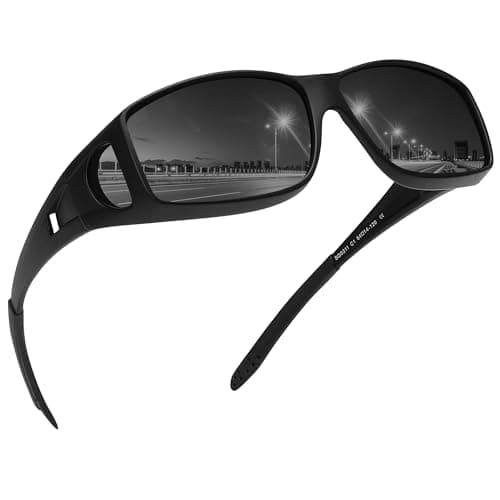
DUCO HD Polarized Fit Over (8960)
Fits over glassesPolarizedUV400Side shields
The fit-over to buy first — genuinely polarized, properly sized, and not embarrassing to wear.
- Glare control
- 8
- Optics
- 7
- Fit & coverage
- 7
- Durability
- 7
- Value
- 9
Pros
- +Genuinely polarized rather than merely tinted, which is not a given in the fit-over aisle
- +The frame is cut close enough to the face that it reads as sunglasses rather than as safety goggles
- +Wraparound side panels block the light that leaks in around a standard pair worn over specs
Cons
- −Like every fit-over, it sits further from your face than normal sunglasses, so it can fog in humidity
- −Only fits frames up to its published interior dimensions — measure your glasses first
Don't buy this if…
…your prescription frames are oversized. Fit-overs have a fixed interior cavity, and a large frame simply will not go in — measure the width and height of your glasses before ordering.
Drivers and anyone in and out of shade
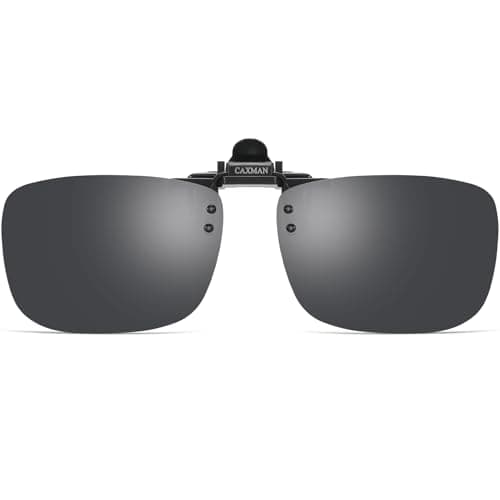
CAXMAN Flip-Up Clip-On (Rimless)
Flip-up clipPolarizedRimless lensMetal clip
A flip-up clip for people who move in and out of sun constantly and hate taking things off.
- Glare control
- 8
- Optics
- 6
- Fit & coverage
- 6
- Durability
- 5
- Value
- 10
Pros
- +Flipping the lens up beats removing and pocketing a clip every time you go inside or under trees
- +Rimless construction keeps the weight down on the bridge of your nose
- +Cheapest way to add polarization to glasses you already own
Cons
- −The flip hinge is the moving part, and moving parts at this price are the first thing to loosen
- −The clip's metal contact points can mark a soft lens coating if grit gets in
Don't buy this if…
…you want the most secure fit. A fixed clip or a fit-over stays put better than a hinge; the flip-up trades a little security for a lot of convenience.
The fit-over you keep for years
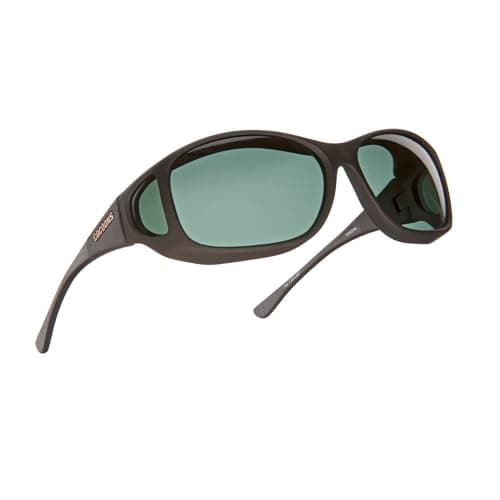
Cocoons Style Line (Polarized)
Fit-over (OveRx) designPolarizedSide shieldsMultiple frame sizes
The premium end of the fit-over category — better optics and a proper build, at a real price.
- Glare control
- 9
- Optics
- 8
- Fit & coverage
- 8
- Durability
- 8
- Value
- 6
Pros
- +Cocoons builds fit-over eyewear as its core product line rather than as an afterthought, and the fit engineering shows
- +Polarized lens quality is a clear step above the sub-$25 fit-over field
- +Offered in several sizes, which is the single most useful thing a fit-over brand can do
Cons
- −Costs several times what a budget fit-over costs, which is a lot for a category most people treat as disposable
- −Still unmistakably a fit-over from the side — no fit-over solves that
Don't buy this if…
…you only need sunglasses over your specs a few times a year. The budget fit-overs do the same job well enough for occasional use, and this premium only pays back with regular wear.
Large prescription frames
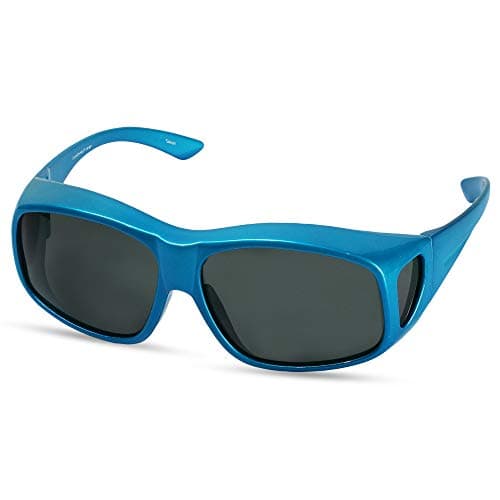
LensCovers Large Polarized Fit Over
Fits over glassesLarge interior fitPolarizedSmoke lens
The one to buy if your prescription frames are big — a genuinely large interior cavity.
- Glare control
- 8
- Optics
- 6
- Fit & coverage
- 7
- Durability
- 6
- Value
- 9
Pros
- +Sized for the large prescription frames that defeat most fit-overs, which is the number-one reason this category disappoints people
- +Polarized, so it removes reflected glare rather than just dimming the scene
- +Cheap enough to keep a pair in the car and a pair in the bag
Cons
- −Large means bulky — this is the least discreet pick in the category
- −Basic build and coatings at this price; treat it as a functional tool, not an accessory
Don't buy this if…
…you wear small or medium frames and care how it looks. A large fit-over over a small pair of glasses is a lot of sunglasses.
The lowest-cost polarized fit-over
MEETSUN Polarized Fit Over
Fits over glassesPolarizedUV400Wrap sides
The cheapest fit-over here that is still genuinely polarized and UV400.
- Glare control
- 8
- Optics
- 6
- Fit & coverage
- 7
- Durability
- 5
- Value
- 10
Pros
- +Polarized and UV400 at the bottom of the price range — the two specs that actually matter are present
- +Wrapped sides cut the side glare that ruins wearing normal sunglasses over specs
- +Cheap enough to buy two and keep one in the glovebox
Cons
- −Frame finish and hinges are exactly what the price implies
- −Fit is generic; no size options to match your prescription frames
Don't buy this if…
…you want a fit-over that lasts years or looks discreet. This is the functional, replaceable end of the category.
Who each pick is for
- DUCO HD Polarized Fit Over— the default for most drivers who wear glasses. Polarized, UV400 and inexpensive, with side shields that help on a bright highway and are the one thing to be aware of at junctions.
- CAXMAN Flip-Up Clip-On (Rimless)— the pick for a drive that goes in and out of shade. A polarized lens that flips up and stays on your glasses, so a tunnel does not involve taking anything off. Minimal bulk, no side coverage, and it only fits the frames it fits.
- Cocoons Style Line (Polarized)— the keeper. A purpose-built fitover frame in several sizes rather than a one-size box, which means a closer fit over your own glasses and less of the perched, floating feeling that makes people give up on fit-overs.
- LensCovers Large Polarized Fit Over— for large prescription frames. If other fit-overs would not close or pressed on your temples, this is the size answer.
- MEETSUN Polarized Fit Over— the cheapest polarized fit-over worth owning. The pair for the glovebox, which is a genuinely good use: the sunglasses you have with you beat the better pair at home.
The polarized-dashboard problem, in plain terms
Polarized lenses are the right answer for driving glare and can be the wrong answer for your particular car. Many LCD instrument clusters, infotainment screens and head-up displays emit polarized light, so a polarizing filter can dim or blank them depending on how you tilt your head. Some cars are unaffected, some go dark only at an angle you never use, and a few are genuinely annoying.
There is a simple test and it takes ten seconds: sit in your own car with the engine on, put the lenses on, and look at every screen while tipping your head left and right. If a display disappears, you have two sane options — a non-polarized tinted fit-over for that car, or the flip-up, which lets you drop the filter out of the way when you want to read something. What we would not do is buy a more expensive polarized lens expecting it to behave differently.
Side shields: good on water, mixed in a car
Most fishing and outdoor fit-overs lean hard on side coverage, and for good reason. In a car it is a trade. The upside is real: a side shield blocks low sun coming in the driver's window and stops reflections bouncing off the back of your prescription lenses. The downside is also real: the shield sits in your far periphery, exactly where you are trying to pick up movement at a junction or glance at a mirror.
Our reading of that trade is that highway drivers should take the coverage and city drivers should give it up. If you spend your time at junctions, in traffic and on roundabouts, buy the closer-fitting or flip-up option and use your visor for the rest.
What about night driving?
No tinted lens belongs on your face after dark, and that includes the yellow lenses sold as night-driving glasses. The clearest evidence we know of is a driving-simulator study in JAMA Ophthalmology (Hwang, Tuccar-Burak and Peli, 2019): yellow-lens glasses did not appear to improve pedestrian detection at night, with or without headlight glare, response times were marginally worse rather than better, and the authors concluded the findings do not support eye care professionals recommending them. The same study found headlight glare slowed detection much more for older drivers — about 1.5 seconds against 0.3 for younger participants — which is an argument for an eye test, not a tint.
If night glare is your actual problem, the things that help are a clean windshield inside and out, an up-to-date prescription, an anti-reflective coating on your own lenses and getting cataract changes checked. We wrote the longer version in can you wear sunglasses at night.
If you do not wear prescription glasses
Buy a normal polarized driving pair instead — better fit, less weight, far more tint choice, and no interior-dimension gamble. The driving sunglasses roundup ranks the field, and best sunglasses for driving into the sun handles the worst case specifically. If you drive for a living, the truck driver guide is the one written for long days in a high cab.
How to choose
Does your car have an LCD cluster or a head-up display?
Test it with a polarized lens before committing. If a screen blanks, take the flip-up or a non-polarized tint for that car.
City or highway?
City, junctions and traffic → lighter side coverage, closer fit. Long bright highway runs → take the side shields.
Does your drive go in and out of shade?
Tunnels, trees, parking garages → a flip-up, every time. It is the one feature that changes the experience rather than the specification.
How big are your glasses?
Measure before you buy. Large or deep frames need the large fit-over rather than a tighter fit of a standard one.
Where will they live?
If the answer is the glovebox, buy the cheap pair deliberately and keep the good one for days you plan.
The cheap stuff that matters
Essentials under $40
The add-ons this page already told you to get. None of these is scored — our rubric measures glare control, optics, fit, durability and value, and four of those mean nothing for a cleaning cloth. So you get a reason and a live price instead of a number we'd have had to invent.
SMARTTOP
SMARTTOP Silicone Eyeglass Ear Grips (18 pairs)
Soft sleeves that slide onto the temple arms so they grip skin instead of sliding on it. The cheapest real fix for a frame that is otherwise the right size.
Chums
Chums Original Cotton Retainer
The plain cotton eyewear keeper. Adjustable, washable, and the version most people mean when they say Croakies. Colorways vary on the listing.
Generic
Floating Sunglasses Straps for Water (4-pack)
A buoyant strap for boats, kayaks and wading. Note what this is: the STRAP provides the flotation. Do not assume any pair floats on its own.
#ad · Live prices as of October 19, 2026, hidden when our data goes stale. We may earn a commission, at no cost to you. How this works.
How we picked
We don't run a testing lab
We compile each pair's published specifications — lens material, polarization, coating, frame material, coverage, UV rating and price — normalize them, and score each against a published rubric. The scores are judgments from documented research; they are notmeasurements we took, because we don't own a lab and we're not going to pretend we do. Pairs we claim to have lab-tested: 0.
Questions
Frequently asked
Are polarized sunglasses good for driving?+
Yes for daytime glare — wet roads, a bright hood and low sun on glass are all reflected light, which is what a polarizing filter removes and a dark tint only dims. The one caveat is your car: polarized lenses can dim LCD dashboards and head-up displays at certain head angles. Test your own car, and if a screen blanks, use a non-polarized tint or a flip-up. Mechanism in
do polarized sunglasses block screens.
Do fit-over sunglasses block your peripheral vision?+
The heavily shielded ones can crop the far edge of your vision, which matters more in a car than anywhere else because that is where mirror and blind-spot checks happen. A closer-fitting fit-over or a flip-up clip-on gives up some stray-light control and gives you the periphery back. For city driving we would take that trade.
Do yellow night-driving glasses help?+
No, on the best evidence available. A 2019 JAMA Ophthalmology driving-simulator study found yellow-lens glasses did not improve pedestrian detection at night, with or without headlight glare, and the authors concluded the findings do not support recommending them. A clean windshield, a current prescription and an anti-reflective coating are the things that actually help — see
can you wear sunglasses at night.
Fit-over or clip-on for driving?+
Clip-on, more often than for any other use — specifically a flip-up. It is light, it does not touch your periphery, and you can lift the filter out of the way for a tunnel without taking anything off at the wheel. The fit-over wins when you want more coverage against low side-on sun, or when your frames will not take a clip.
What lens tint is best for driving?+
Brown or amber for contrast on a gray road and in low sun; neutral gray if you mainly want comfort in bright light and true color. Avoid very dark lenses for dawn and dusk driving, and avoid category 4 lenses entirely — they are not intended for driving. Full breakdown in
best lens color for driving.
Can I just wear my prescription glasses with the visor down?+
For brief low sun, often yes, and it costs nothing. The visor handles light from above; it does nothing about glare reflecting up off the road surface or off a wet hood, which is the glare that actually tires you out on a long bright drive. That is the gap a polarized lens fills.
Receipts
Sources
We do not run a testing lab, and we do not pretend to. Where a spec or measurement came from a manufacturer or a third party, we name and link it. Where we could not verify something, we say so on the page rather than quietly leaving it out. Read our full method.