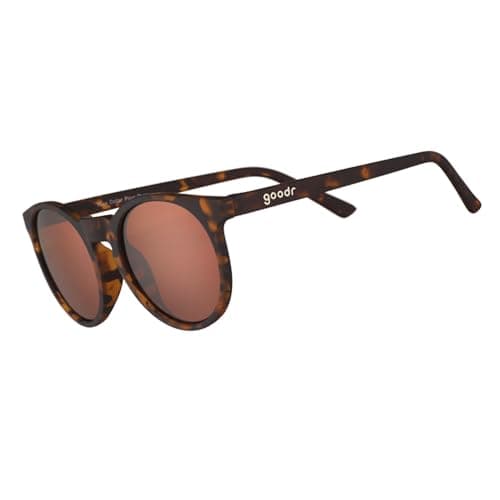
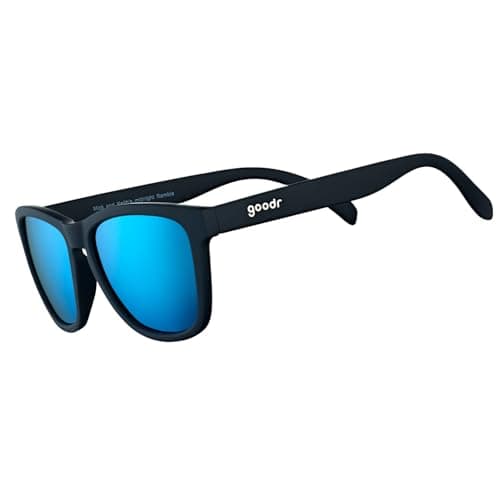
goodr, minus the hype
goodr built its business on one narrow, honest promise: a polarized, UV400 running sunglass in a light frame that grips your face, sold at a price where losing a pair is a shrug rather than a wound. The branding around it is loud — the joke product names, the cartoon marketing — but the product underneath is refreshingly plain, and that plainness is exactly why the OG became a default on run-club Saturdays and race start lines. There is no lab-coat origin story here and no claim to reinvent optics. It is a competent polarized lens in a frame that stays put, sold cheap. For a runner, that is most of what actually matters.
What goodr gets right
The no-slip grip coating is the real product, and it works. Most lifestyle frames use smooth plastic arms that get slicker as your face heats up and sweats — precisely backwards for running. goodr coats the arms and nose bridge with a grippy layer that tacks up as you sweat, so the pair stops migrating down your nose by mile three. If you have ever spent the back half of a run pushing your sunglasses up, that single feature is the whole reason people keep buying the brand.
- Genuinely polarized and UV400 — the two features that actually protect your eyes and cut glare — at a price near the floor of the market.
- Light enough to forget by the second mile, with no temple ache over distance.
- Cheap enough that the true cost of ownership, which is losing them, barely registers.
goodr also earns points for range without complicating the pitch. The round, smaller-fit Circle G exists for faces the wider OG overwhelms, and it runs the same polarized lens and the same grip trick. If you want the full field of grippy running frames side by side, our best running sunglasses roundup puts goodr next to its rivals on the two things that decide a run: grip and weight.
Fit is the one thing to get right
Because the OG is a single size, fit is the only real gamble with goodr, and it is an easy one to lose if you buy on looks alone. The standard OG suits a broad range of faces, but a narrow face can end up with the arms sitting loose and the lens perched too wide, while the round Circle G solves exactly that by hugging a smaller face more closely. goodr has since branched into a handful of other shapes and lens tints, from mirrored finishes to different base colors, but the lens quality and grip coating are consistent across the line — so the decision is genuinely about shape and tint, not about which pair has the "better" optics. Pick the frame that fits your face, and the rest of the goodr promise takes care of itself.
What goodr gets wrong (or just does not do)
The honest limits are about coverage and polish, not the fundamentals. The OG is one size, so a very narrow or very wide face may not get a perfect seal, and the lens is fairly flat — it lets more side light in than a true sport shield with wraparound coverage. The lens coatings are budget-grade too: treat a pair as a season or two of hard use, not a decade. And goodr does not build an interchangeable-lens system, so you cannot swap tints for changing light the way a dedicated cycling frame lets you. None of this is a flaw at the price; it is simply the ceiling of a sub-$40 frame, and goodr never pretends otherwise.
The lens and frame tech, explained honestly
A polarized lens is a filter, not just a darker tint. Light bouncing off a flat surface like a wet road comes back horizontally aligned, and that alignment is glare; the polarizing layer blocks that horizontal light so the shine drops away. goodr's lenses do this and add UV400, which blocks essentially all UVA and UVB — the single most important thing any sunglass does for your eyes, and something we break down in our UV protection guide. What goodr does not do is contrast tuning: there is no fish-lifting filter like Costa's 580 or a course-reading tint like Oakley's Prizm. For running that absence costs you nothing, because a runner needs glare control and grip, not a specialized contrast lens.
How goodr's pricing compares
This is where goodr looks smart. It sits far below the premium running names yet delivers the two features a runner truly uses — polarization and sweat-activated grip. Against a lifestyle frame costing several times more, goodr wins for running specifically, because the expensive frame lacks the grip. Against its closest budget rival, the gap is grip feel and fit, not fundamentals: we put the two head to head in our Knockaround review, and the short version is that goodr's coating holds better on a sweaty face while Knockaround wins on colorways and raw impact toughness.
Are goodr sunglasses worth it?
For most runners and walkers, yes — emphatically. You get a polarized, UV400 lens and a grip system that keeps the frame still, at a price that makes replacement a non-event. Amazon buyers frequently note the same thing runners say in person: the pair simply does not slide. That is the entire job, and goodr does it for the price of a couple of energy-gel packs. The value math is hard to argue with, which is why the brand keeps showing up on start lines.
Who should skip goodr
Skip goodr if you need maximum wraparound coverage or interchangeable lenses for changing light — goodr is fit-and-forget, not a modular sport system. Skip it if optical precision is your first priority; the budget coatings and flat lens give up clarity to pricier sport optics. And skip it for serious sight-fishing: a runner's glare lens is not a fishing contrast lens, and our fishing sunglasses roundup points you at the 580-class lenses that genuinely pull fish out of surface glare. If you are new to sport sunglasses and unsure where to start, our beginner running guide walks through the whole first-pair decision.