Top pick
Top pick
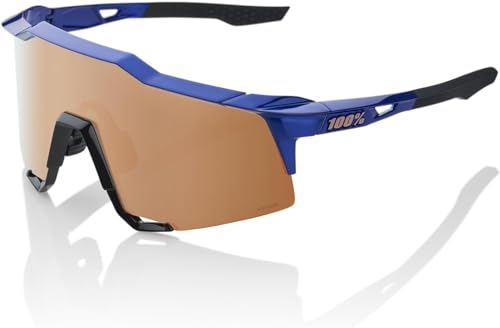
100% Speedcraft (HiPER Mirror)
Best for: Maximum field of vision at speed
The widest uninterrupted field of view under this ceiling, in a race frame that weighs almost nothing and has no bottom rail to bounce into your cheekbones. Best for the runner who wants the lens to disappear and has decided that coverage matters more than looking normal.
#ad · we may earn a commission. Live prices from the Amazon Product API, as of November 23, 2026. Where we have no verified live price we show none.
You can run happily in a thirty-dollar pair of sunglasses. We say so on best budget running sunglasses, where the ceiling is about thirty-five dollars and the winner is excellent. This page exists because there is a real second tier above that, and because the running cluster on this site has never had a page for it — fishing, cycling, golf and polarized all have a hundred-dollar rung, and running jumped straight from budget to the price-blind hub.
So what does the extra money buy a runner? Four things, and none of them is the glare filter. Retention comes first: hydrophilic grip material that gets grippier as it gets wet, rather than a rubber pad that gets slick. Ventingsecond — running is slow enough that frames fog where they would not on a bike, and a vented frame is the fix. Field of view third: a single tall lens with no bottom rail puts nothing in your eyeline when you look down at your feet on a trail. Lens adaptability fourth, because a run that starts in bright sun and finishes under trees is the one problem a fixed dark lens cannot solve. A retailer buying guide for running and cycling eyewear sets out the same criteria, which is reassuring: they are not our invention.
Polarization is the interesting argument in this band, and it is not a straightforward yes. Polarized lenses remove reflected, horizontally oriented light, which on a road means less bounce off wet tarmac and car bodies. On a technical trail it also removes the sheen that tells you a rock is wet, and plenty of trail runners genuinely prefer a non-polarized contrast tint for that reason. Three of the seven picks here are polarized and four are not; the table says which is which, and we have ordered them on retention and coverage rather than on that split.
One pick here is the most interesting lens in the band and the most expensive: a polarized light-reactive lens, which means one lens that both cuts reflected glare and lightens as the sun goes down. Tifosi publishes its lens range and what each one does, and that combination does not exist lower down this page. It is ranked third rather than first because a light-reactive lens is always a compromise at both extremes — it never gets as dark as a dedicated dark lens nor as clear as a clear one.
Nothing here was tested on a run by us. The ranking uses published grip, venting and lens claims from makers and named outlets, frame geometry, and live prices — and the budget pick is the thirty-dollar pair from the band below, because on a page about what the step up buys, the honest thing is to show you the option that does not take it.
The short answer
Quick picks
#ad · Live prices from the Amazon Product API, as of November 23, 2026. Where we have no verified live price, we show none — we would rather leave a gap than print a number that has rotted.
In detail
The picks, in full
Maximum field of vision at speed
100% Speedcraft (HiPER Mirror)
HiPER mirror lensCylindrical shieldVentedRace fit
The big-field-of-vision race shield, with a mirrored contrast lens tuned for road and trail.
- Glare control
- 6
- Optics
- 9
- Fit & coverage
- 10
- Durability
- 8
- Value
- 6
Pros
- +One of the largest usable fields of view in the category — you look through lens, not over it, in a racing position
- +The HiPER mirror lens lifts contrast while shedding light before it enters, a genuine combination on a bright day
- +Race-tuned fit that stays locked on at speed
Cons
- −Single lens per pair; changing light means buying and carrying a second one
- −The mirror finish shows scuffs sooner than a plain lens and the styling is unapologetically racy
Don't buy this if…
…you want a subtle frame or a lens set in the box. This is a race shield with a race price and a race look.
Best cycling sunglasses for the money
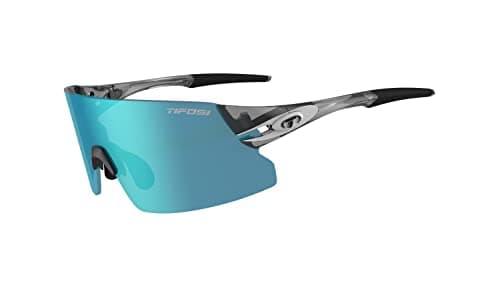
Tifosi Rail XC (Interchangeable)
Interchangeable lensesBig shieldVentedVery light
The value pick for cyclists: big coverage and three lenses for changing light.
- Glare control
- 6
- Optics
- 8
- Fit & coverage
- 10
- Durability
- 8
- Value
- 9
Pros
- +Ships with multiple lenses so you swap for bright sun, overcast and low light — the right answer for a sport where light changes mid-ride
- +Large shield gives the coverage a road or gravel cyclist actually needs at speed
- +A fraction of the price of the Italian marquee brands for comparable coverage
Cons
- −The included lenses are tinted/contrast, not polarized — deliberate, since polarized can mask road sheen and dims a bike computer
- −Big-shield look isn't for everyone off the bike
Don't buy this if…
…you want a do-everything lifestyle frame. This is a cycling tool — glorious on the bike, a lot of sunglasses at a cafe.
Polarized glare control in changing light
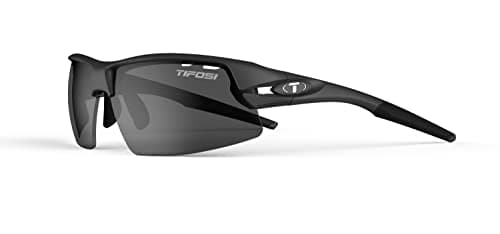
Tifosi Crit (Polarized Fototec)
Fototec photochromicPolarizedSport frameHydrophilic grip
The rare lens that is both polarized and photochromic — glare control that also tracks the light.
- Glare control
- 8
- Optics
- 8
- Fit & coverage
- 8
- Durability
- 7
- Value
- 7
Pros
- +Combines the two lens tricks most brands make you choose between: it darkens with the light AND cancels reflected glare
- +Sport shape and grip pads mean it stays put through a ride, a run or a long day outside
- +A far cheaper route to a polarized photochromic lens than the premium marques charge
Cons
- −Being polarized, it still dims a bike computer or a boat chartplotter — the photochromic half does not fix that
- −Photochromic lenses transition slower in the cold and never reach the darkness of a fixed bright-sun tint
Don't buy this if…
…you ride with a head unit. A polarized lens is the wrong tool there no matter how clever the photochromic layer is — take a non-polarized photochromic instead.
Coverage without giving up the grip
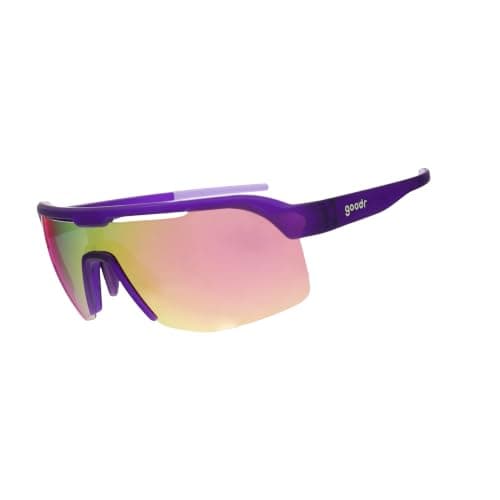
goodr Bolt G (Polarized Wrap)
PolarizedUV400Vented wrap lensAdjustable nose piece
The OG's grip coating in a vented wrap — goodr for runners who want coverage rather than a lifestyle shape.
- Glare control
- 8
- Optics
- 7
- Fit & coverage
- 9
- Durability
- 7
- Value
- 8
Pros
- +A wrap lens seals out the low, side-on sun that gets straight past goodr's flat OG frame
- +The adjustable nose piece is the thing the OG does not have — it is how you stop a wrap sitting wrong on a narrow or a high bridge
- +Same polarized UV400 lens and no-slip grip coating as the rest of the goodr line, so nothing is traded for the extra coverage
Cons
- −Half again the price of the OG, which is a lot for goodr money
- −More lens close to your face means more to fog at a slow, humid pace than the open OG frame, vents or not
- −goodr colorways rotate constantly and each listing is one color in one size — the exact pair here may sell through
Don't buy this if…
…you want one pair that works on the run and at dinner. The wrap reads as sports equipment in a way the OG does not, and that is the entire point of it.
Light everyday and easy runs
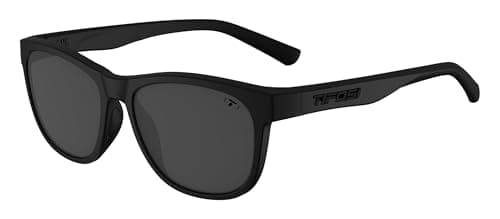
Tifosi Swank
Grilamid frameSingle lensHydrophilic gripVery light
A featherweight lifestyle-sport crossover that disappears on your face.
- Glare control
- 5
- Optics
- 7
- Fit & coverage
- 7
- Durability
- 7
- Value
- 9
Pros
- +One of the lightest frames here — barely-there for easy runs and all-day wear
- +Tifosi's grip pads tack up with sweat, so it stays put better than a fashion frame
- +Tifosi's build-quality reputation at a genuinely low price
Cons
- −The base Swank lens is a tinted non-polarized lens, not polarized — no glare-off-water benefit
- −Lifestyle shape, so less coverage than Tifosi's true sport shields
Don't buy this if…
…you specifically need polarized glare control. The Swank is a light tinted frame; for glare off wet roads look at a polarized pick instead.
Cheapest usable photochromic shield
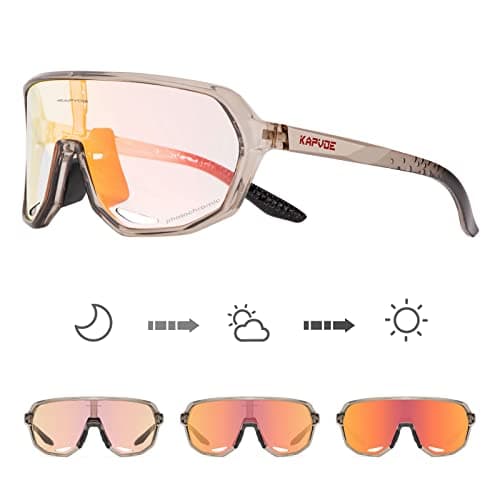
KAPVOE Photochromic (K63)
Photochromic lensUV400Large shieldLightweight frame
A photochromic sport shield at a price that makes the premium photochromics hard to justify.
- Glare control
- 6
- Optics
- 6
- Fit & coverage
- 8
- Durability
- 6
- Value
- 10
Pros
- +Gets you the one-lens-covers-the-ride advantage for the price of a couple of inner tubes
- +Big shield coverage that a lifestyle frame cannot match at any price
- +Non-polarized, which is the correct choice for reading a bike computer
Cons
- −The transition is narrower and slower than a premium photochromic, and slower again in the cold
- −Budget hinges and coatings; treat it as a season-or-two frame
Don't buy this if…
…you want the widest possible light range. The premium photochromics genuinely cover more of the spectrum and switch faster.
Best running sunglasses overall
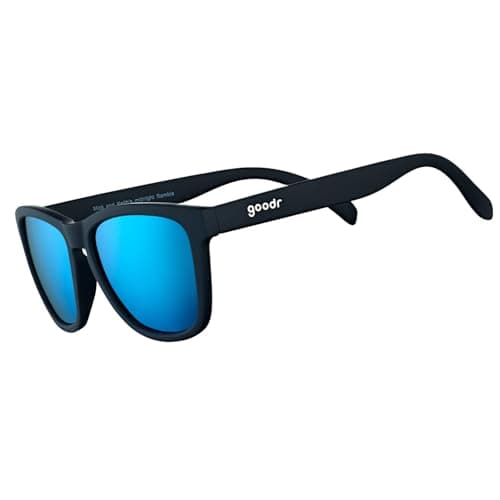
goodr OG (Polarized)
PolarizedUV400No-slip grip coating~ standard fit
The runner's default: polarized, no-slip, and cheap enough to not baby.
- Glare control
- 8
- Optics
- 7
- Fit & coverage
- 8
- Durability
- 7
- Value
- 10
Pros
- +goodr's grip coating genuinely stops the bounce and slide that ruins a run in a lifestyle frame
- +Polarized and UV400 at a price where losing a pair doesn't sting
- +Light enough that you forget you're wearing them by mile two
Cons
- −One size; a very narrow or very wide face may not get a perfect seal
- −Flat-ish lens gives less side coverage than a true sport shield
Don't buy this if…
…you want maximum wraparound coverage or interchangeable lenses for changing light. goodr is fit-and-forget, not a modular system.
Who each pick is for, and what is wrong with it
- 100% Speedcraft (HiPER Mirror) — Best for: runners who want maximum coverage and nothing in their eyeline, and the default here. A single tall lens with no bottom rail, a race-light frame, and 100%'s published HiPER mirror claims — a mirror sheds light before it enters the lens, which is the right trick on open roads in summer. Honest cons: it is not polarized; the mirror scuffs sooner than a plain lens; the frame is large enough to look conspicuous off a run; and there is no lens adjustment at all.
- Tifosi Rail XC (Interchangeable) — Best for:runners whose light changes between outings — dawn, midday and dusk in the same week. It ships as a lens set, so you match the lens to the run instead of averaging, with the coverage a named outlet describes as huge, plus lifetime cover against manufacturer's defects. Honest cons: you have to carry and remember the spare lenses; none is polarized; the shield fogs when you stop; and the warranty excludes wear, loss and damage.
- Tifosi Crit (Polarized Fototec) — Best for:one lens for everything, and the only pick here that is both polarized and light-reactive — Tifosi documents the Fototec range as light-reactive and its polarized material as injected rather than coated. If you run the same route at wildly different times and refuse to carry a case, this is the answer. Honest cons: it is the top of the band in price; a light-reactive lens never gets fully dark or fully clear; and polarization costs you the wet-rock sheen on technical trail.
- goodr Bolt G (Polarized Wrap) — Best for:runners who want wrap coverage without giving up the grip coating, and the only pick here with an adjustable nose piece — which is the fix for the category's real weakness on narrow faces. Honest cons: the frame is soft plastic and will bend if you sit on it; no venting to speak of, so it fogs on slow climbs; and no interchangeable lens.
- Tifosi Swank — Best for:easy runs and the pair you will also wear to the shops. It is the lightest frame on this page and the most normal looking, with Tifosi's lifetime defect cover behind it. Honest cons: this listing is not polarized; it is a flat lifestyle-sport shape, so side light gets in and coverage is the least here; and there is no venting, which you notice on a hot slow run.
- KAPVOE Photochromic (K63) — Best for: the cheapest way to get a light-reactive shield, if the Crit is out of budget. A shield shape with a lens that darkens and lightens, for a fraction of what the branded version costs. Honest cons:it is not polarized; the published specs are thin — no transmission range we could verify; the reaction is slower than a premium photochromic; and build quality is visibly a tier below everything above it.
- goodr OG (Polarized) — Best for: the budget pick, and most runners most of the time. The grip coating is the thing: goodr publishes polarized, UV400 and no-slip grip across the range, and a pair that does not move is worth more on a run than a better lens that does. Honest cons: minimal coverage and no venting; soft plastic frame; one price for the whole range, so there is no cheaper goodr; and no interchangeable or reactive lens option. It is the winner on best budget running sunglasses, and it is here as the floor of this band rather than its ceiling.
Retention beats everything else
A pair of sunglasses that slides down your nose at mile four is worse than no sunglasses, because you spend the rest of the run pushing them up. The materials that fix this are hydrophilic rubber at the nose and temples, which grip harder when wet rather than slicker — Tifosi describes the approach on its own product pages, and goodr's grip coating is the same idea applied to the whole frame. If you already own a pair that slips, a retainer is a five-dollar fix and the method is at how to stop sunglasses slipping.
Why fogging is a running problem and not a cycling one
Airflow. At cycling speed there is enough air moving across the lens to clear it; at running pace, especially uphill, there is not, so your own breath and head heat condense on the inside of the lens. The mitigations are a vented frame, a lens that sits slightly away from your face, and not wearing a buff over your nose. Two picks here are vented sport frames and two are flat lifestyle shapes that will fog on a slow climb — it is in the table.
Polarized, reactive, or fixed?
Polarizedif you run on roads in bright sun, where reflected glare off tarmac and cars is the problem — that reflected, horizontally oriented light is exactly what the filter removes. Light-reactive if your runs start and end in different light and you will not carry a spare lens. Fixed non-polarized if you run technical trail, where the wet-rock sheen is information you want. See best polarized running sunglasses and best sunglasses for trail running.
| If this is you | Buy | Polarized? |
|---|
| Maximum coverage, nothing in your eyeline | 100% Speedcraft (HiPER Mirror) | No |
| Dawn, midday and dusk runs in one week | Tifosi Rail XC (Interchangeable) | No |
| One lens for everything, no spares carried | Tifosi Crit (Polarized Fototec) | Yes, and light-reactive |
| Wrap coverage and a nose piece that adjusts | goodr Bolt G (Polarized Wrap) | Yes |
| Easy runs and everyday wear in one pair | Tifosi Swank | No |
| Cheapest light-reactive shield | KAPVOE Photochromic (K63) | No |
| Most runners, most of the time | goodr OG (budget pick) | Yes |
The cheap stuff that matters
Essentials under $40
The add-ons this page already told you to get. None of these is scored — our rubric measures glare control, optics, fit, durability and value, and four of those mean nothing for a cleaning cloth. So you get a reason and a live price instead of a number we'd have had to invent.
SMARTTOP
SMARTTOP Silicone Eyeglass Ear Grips (18 pairs)
Soft sleeves that slide onto the temple arms so they grip skin instead of sliding on it. The cheapest real fix for a frame that is otherwise the right size.
Chums
Chums Original Cotton Retainer
The plain cotton eyewear keeper. Adjustable, washable, and the version most people mean when they say Croakies. Colorways vary on the listing.
Generic
Floating Sunglasses Straps for Water (4-pack)
A buoyant strap for boats, kayaks and wading. Note what this is: the STRAP provides the flotation. Do not assume any pair floats on its own.
#ad · Live prices as of November 23, 2026, hidden when our data goes stale. We may earn a commission, at no cost to you. How this works.
How we picked
We don't run a testing lab
We compile each pair's published specifications — lens material, polarization, coating, frame material, coverage, UV rating and price — normalize them, and score each against a published rubric. The scores are judgments from documented research; they are notmeasurements we took, because we don't own a lab and we're not going to pretend we do. Pairs we claim to have lab-tested: 0.
Questions
Frequently asked
Are $100 running sunglasses better than $30 ones?+
In four specific ways: grip material that works when wet, venting that stops fog on slow climbs, a taller lens with no bottom rail in your field of view, and lens options a fixed cheap pair cannot offer. The glare filter and the UV block are the same. If your thirty-dollar pair stays on your face and does not fog, you have already solved the problem and the upgrade is optional — which is why the budget pick on this page is a thirty-dollar pair.
Should running sunglasses be polarized?+
On roads, usually yes — reflected glare off tarmac and car bodies is the main irritation and polarization removes it. On technical trail, often no: the same filter removes the sheen that tells you a rock or root is wet, and that is information your feet want. The cleanest compromise in this band is a polarized light-reactive lens, which is the third pick here. More at
best polarized running sunglasses.
How do I stop running sunglasses bouncing?+
Three things, in order of effect: buy a frame with hydrophilic grip at the nose and temples rather than plain plastic; choose a frame light enough that there is little mass to bounce; and if it still moves, fit a retainer. Frames ranked specifically on retention are at
best no-slip running sunglasses, and the fixes for a pair you already own are at
how to stop sunglasses slipping.
Do I need a vented frame?+
If you run slowly, uphill, or in humidity, yes — running does not generate enough airflow to clear a lens the way cycling does, so your breath condenses on the inside. If you run fast on flat roads in dry air, a flat lifestyle frame is fine and will look better. Two of the picks here are vented sport frames and the table marks the ones that are not.
Receipts
Sources
We do not run a testing lab, and we do not pretend to. Where a spec or measurement came from a manufacturer or a third party, we name and link it. Where we could not verify something, we say so on the page rather than quietly leaving it out. Read our full method.