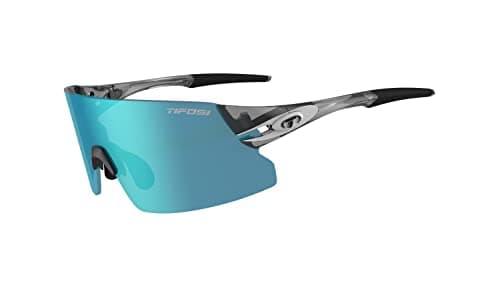
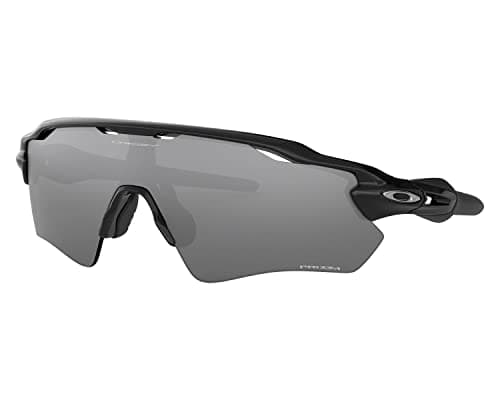
Mostly no, with two real exceptions. A polarized lens does not change how your two eyes triangulate distance, so your underlying depth perception is intact. What it does do is remove the surface reflections you use as depth and texture cues — the sheen that tells you a patch of road is wet, the glint that marks ice, the shine that reveals the slope of a green — and, on a steeply curved lens or through laminated glass, it can introduce visual artefacts. If your sport or job depends on reading surfaces at speed, wear a non-polarized contrast lens like the Oakley Radar EV Path or the Tifosi Rail XC above instead.
This question gets asked in two very different ways, and they have different answers. "Will polarized lenses make me misjudge distances?" — for the overwhelming majority of wearers, no. "Do athletes and pilots avoid them for a reason?" — yes, and the reason is real. The rest of this page separates the two.
What to look for if this is your concern
A non-polarized contrast tint. This is the specific answer: a lens that boosts contrast without filtering reflected light. Oakley sells most of its Prizm sport range unpolarized for exactly this reason, and Tifosi does the same across much of its line. You keep glare reduction by darkness, and you keep the surface cues.
Interchangeable lenses, if you move between environments. One frame, a dark contrast lens for bright days and a clear or light one for flat light, means you never have to accept a lens that is wrong for the conditions.
A flatter lens, or a quality curved one. Artefacts are most noticeable on cheap, steeply wrapped lenses where the polarizing film and the curvature interact. A well-made shield does not do this; a $12 wrap sometimes does.
The option to take the filter out of the equation.For drivers and pilots who want polarized some of the time, a clip-on or flip-up is a cleaner solution than committing a whole pair — see prescription polarized sunglasses.
Why polarization does not change binocular depth perception
Depth perception comes mainly from binocular disparity — your brain comparing two slightly different images and computing distance from the difference. A polarized filter in front of both eyes removes the same plane of light from both images, so the disparity between them is unchanged. That is why an optometrist will tell you a properly made pair of polarized sunglasses does not impair stereopsis, and why millions of drivers wear them without incident. The Cleveland Clinic recommends them for driving precisely because the glare reduction improves what you can see.
The caveat is matching. If the two lenses of a pair have their polarizing axes misaligned, or one lens is polarized and the other is not, the two eyes get meaningfully different images and the brain has to reconcile them. Sunglass Science puts it this way: polarized lenses "can occasionally affect how light reaches each eye, particularly if there are inconsistencies in the polarization," which can disrupt how the images merge. That is a manufacturing-defect problem, not a property of polarization, and it is rare in a reputable pair.
The real effect: removed cues, not broken vision
Here is the part that matters practically. A great deal of what feels like depth perception outdoors is actually surface reading: you know that patch of tarmac is wet because it shines, you know that rock is icy because it glints, you know how a green slopes partly from how light moves across it. Those cues are reflected light. A polarized lens removes reflected light. So the information disappears, and your judgement of the surface gets worse even though your eyes are working perfectly.
Sunglass Science makes the same point about winter conditions: glare off ice patches is a warning signal, and removing it makes hazardous spots harder to detect. It also notes that Oakley and other sport brands make most of their sport lenses non-polarized, particularly for professional athletes where small changes matter. This is exactly the argument we make for cycling in are polarized lenses good for cycling and for the golf course in polarized sunglasses for golf.
Where the artefact problem is real: cockpits and windscreens
The strongest institutional position against polarized lenses comes from aviation. The FAA's pilot sunglasses brochure advises against polarized lenses in the aviation environment on three grounds: they can reduce or eliminate the visibility of instruments that use anti-glare filters, they can interfere with visibility through a windscreen by enhancing striations in the laminated material, and they can mask the sparkle of light reflecting off another aircraft — which is how pilots spot traffic. Note that only the second of those is an optical distortion; the other two are removed information, the same mechanism as the wet-road example.
A car windshield is laminated too, which is why some drivers see faint blotchy patterns through polarized lenses, and why a polarized lens can reveal the stress pattern in tempered side windows. For most people this is a curiosity. For anyone who needs to read a large LCD dashboard, it is a reason to test first. More on the screen side of this in do polarized sunglasses block screens.
Who should actually avoid polarized lenses
Pilots, per the FAA. Operators of equipment with critical LCD displays. Anyone whose sport depends on reading a surface at speed — mountain bikers and trail runners picking lines over wet rock, skiers reading ice, golfers reading a green, and fast ball-sport players tracking a ball against sky. And anyone who simply finds them disorienting: a minority of wearers report that the world looks subtly more three-dimensional through polarized lenses, and if that bothers you, that is a sufficient reason not to wear them.
Everyone else, including the overwhelming majority of drivers, is better off with the filter than without it. If you want the general argument rather than the exceptions, read polarized vs non-polarized and the polarized sunglasses myths we keep hearing.
The short version
Polarized lenses do not damage your depth perception. They delete surface reflections, and sometimes you were using those reflections to understand a surface. Decide by activity: wear polarized for driving, water and general use; wear a non-polarized contrast lens for technical sport, for flying, and for anything where a screen or a wet surface is load-bearing.
The one setting where authorities act on this
Aviation. Both the FAA and the UK Civil Aviation Authority discourage polarized lenses in a cockpit, and the reasoning overlaps with everything above: instrument displays go dark, windscreens show stress striations, and the sun glint that reveals distant traffic is exactly the reflection the filter removes. Can pilots wear polarized sunglasses quotes the guidance and ranks the non-polarized options that meet it.