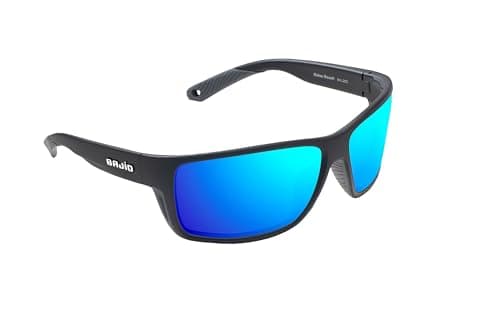
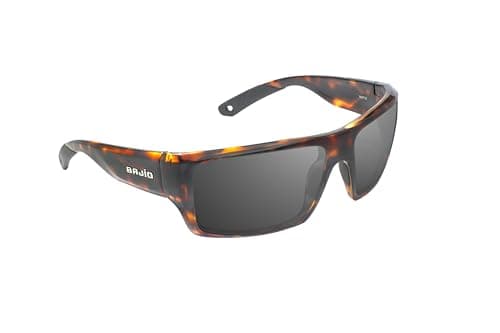
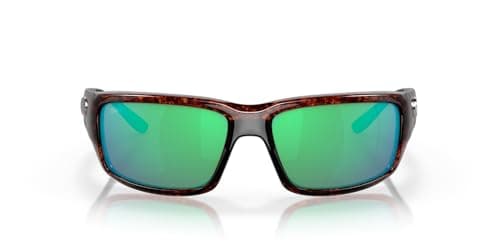
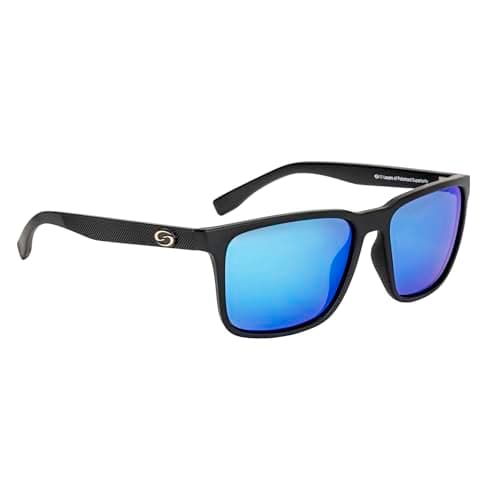
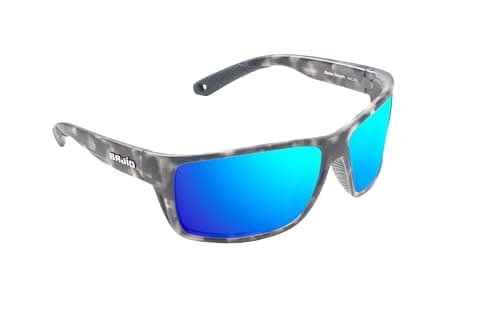
If you are buying one Bajío and it has to do everything, buy Green Mirror — a brown amber base at 12% light transmission, which Bajío itself calls the lens it would pick if it could only pick one. If you fish offshore in open water, buy Blue Mirror, the darkest lens in the range at 10%. If you sight-fish shallow water for fish that match the bottom, buy Rose Mirror at 18%. If you fish rivers and lakes, buy Silver Mirror at 14%. And if you are running before sunrise or under heavy tree cover, Violet Mirror at 22% is the only lens here built for that light.
Bajío is a small brand with an unusually simple lens story, and the simplicity is the reason this page can be short on hedging. Per its official lens color guide: “Seven lens colors. All polarized. All built with LAPIS, our patent-pending blue light-blocking technology.” There is no non-polarized line to buy by mistake, no upgrade tier, and no lens in the range that skips the brand's signature filter. The only decision is the tint, and the tint is chosen by light level and water type rather than by looks.
Every Bajío lens, with the published numbers
These are Bajío's own published figures — base color and light transmission (LT) per lens, with the conditions the brand names for each. Light transmission is the share of visible light the lens lets through, so a lower number is a darker lens.
| Lens | Base | Published LT | Built for |
|---|
| Violet Mirror | Yellow | 22% | Low light — first and last light, heavy cloud, tree cover, running a boat in weather |
| Rose Mirror | Light copper | 18% | Sight fishing — low-contrast fish that match the bottom, and still usable in full sun |
| Silver Mirror | Copper | 14% | Medium light — rivers, lakes and stillwater |
| Copper | Copper (no mirror) | 14% | Medium light — the original fishing tint, dry fly and freshwater |
| Green Mirror | Brown amber | 12% | Bright light, all-round — fish near structure, high summer sun |
| Gray | Gray (no mirror) | 12% | Bright light, low-key — all-day comfort rather than maximum contrast |
| Blue Mirror | Gray | 10% | Bright light offshore — open ocean, spotting fish in 50ft or more of water |
One honest note before you use that table as gospel. The retailer SportRx publishes its own Bajío chart with figures two to four points different on several lenses — Blue Mirror at 12% rather than 10%, Green Mirror at 14% rather than 12%, Silver and Gray and Copper at 16% — and it lists base colors differently too. We have not measured either set, and we are not going to pretend to adjudicate between a brand and its retailer. What both agree on is the order: Blue is the darkest, Green sits next to it, Silver and Copper are the middle, Rose is brighter, Violet is the brightest. Buy on the order, not on the decimal.
What LAPIS actually filters
Every lens in the range carries it, so it is worth understanding what the claim is. Per Bajío's lens technology page: “By blocking 95% of blue light up to 445 nm, our sunglasses are the clearest lenses available because they block more blue light than any other brand on the market.” The brand's blue-light explainer splits the spectrum the way an optician would: 400-445 nanometers is the short, scattering “bad blue” it filters, while 445-500 nanometers is the “good blue” it deliberately passes through, because that band carries depth and color information you want when you are looking into water. It also notes that the sun produces up to a hundred times more blue light than a phone, a laptop or a TV, which is the actual reason a blue-light argument belongs on fishing sunglasses rather than on office glasses.
That is a coherent mechanism and it matches what the lens does in the hand: short-wavelength light is the part that scatters most in the atmosphere and in the top few inches of water, so removing it reduces the haze that sits between you and a fish. Two caveats we will state plainly. First, “the clearest lenses available” and “more blue light than any other brand” are superlatives we cannot verify — no independent lab figures exist for the comparison, and we do not run a lab. Second, the blue-light filter is a contrast technology, not a glare technology: the glare removal comes from the polarizing filter, which the Cleveland Clinic describes as blocking the horizontally reflected light coming off a water surface, and which works the same way in a cheap polarized lens as in this one.
The seven lenses, one at a time
- Blue Mirror (gray base, 10% LT)— the offshore lens, and Bajío's darkest. The brand's own framing is blunt: this lens “has one job, spot fish in 50ft+ of water”, for running weed lines and long bluewater days. Where it is wrong:inshore and on the flats, where Bajío itself says it is “generally overkill” and you want more contrast and a brighter base.
- Green Mirror (brown amber base, 12% LT)— the do-everything lens, and the one the brand picks if it could only keep one. The amber base gives you the contrast to separate a fish from a mangrove branch; the green mirror keeps bright open water from wrecking your eyes. Where it is wrong:dawn and dusk, and heavy tree cover — at 12% there simply is not enough light getting through.
- Gray (gray base, no mirror, 12% LT)— the same light level as Green Mirror without the mirror finish, for anyone who wants the lens without the look. The brand is candid that it is “more of a comfortable all-day vision lens than a spot-that-tail-at- 60-feet lens”. Where it is wrong: sight fishing, where a mirrored contrast lens genuinely outperforms it.
- Silver Mirror (copper base, 14% LT)— the freshwater pick: rivers, lakes and stillwater, where the copper base warms the view and helps separate a fish from rock and shadow. Bajío describes it as a medium-light lens with room to move in both directions. Where it is wrong: long days on open salt water in high sun, where Green or Blue carry more.
- Copper (copper base, no mirror, 14% LT)— the traditional fishing tint, mirrorless, for dry-fly anglers and anyone who learned to fish before mirrors existed. Bajío keeps it in the lineup on the grounds that it has always worked. Where it is wrong: if you want maximum contrast per dollar, the mirrored lenses are doing more work.
- Rose Mirror (light copper base, 18% LT)— the specialist sight-casting lens, and the interesting one. It is brighter than Copper or Green, which is counterintuitive for full sun, but the argument the brand makes is that it wins on contrast rather than on exposure: it makes a fish pop against a background it matches. Where it is wrong: on a boat in relentless open-water glare, where you will want the extra two stops of darkness.
- Violet Mirror (yellow base, 22% LT)— the low-light lens, the brightest Bajío makes, built for first and last light, squalls and fishing under canopy. The brand adds a genuinely useful secondary use: running a boat in bad weather, where low light plus spray plus cloud is exactly the condition it brightens. Where it is wrong:midday on the flats, where Bajío says outright that you can wear it but “you won't want to”.
Glass or polycarbonate
Bajío sells “14 different lenses, for 14 scenarios” — which is the seven colors in two materials. The brand's own summary is the honest one: glass “is harder and more scratch-resistant… However, glass is heavier”, while polycarbonate “lenses are impact-resistant and lightweight… yet they will scratch easier than glass”. Both carry an oleophobic coating that the brand says repels water, fingerprints, skin oils and sunscreen residue, which matters more than it sounds on a day when you are handling fish.
The practical rule we would give: glass if the pair lives in a case or on a console, polycarbonate if it lives on your face for ten hours or near a moving hook.One availability note worth knowing before you fall in love with a tint — per SportRx's chart, glass is offered in Blue, Green, Silver and Gray, while Rose, Violet and Copper are polycarbonate only, and Violet Mirror is not available in prescription at all. If you want Rose in glass, that is not a choice Bajío offers.
The listings we link to are specific frames in specific colorways, so check which lens the listing actually carries before you buy— on a pair of Bajíos the lens is the decision this whole page is about, and two listings for the same frame can be two different purchases. The glass and poly builds of the Bales Beach are both in our catalog for exactly that reason.
Picking by water rather than by chart
Flats and shallow saltwater
Green Mirror if you want one lens, Rose Mirror if you are specifically hunting fish that blend into the bottom. The full-wrap frames are the ones to put it in — side light is what washes out a flat. The wider field for this job is ranked in our fly-fishing picks.
Offshore and open ocean
Blue Mirror, in glass if you can live with the weight. Nothing else in the range is built for fourteen hours of staring at bluewater, and the darkness is the point rather than a side effect.
Rivers, lakes and bass water
Silver Mirror or Copper. The copper base is the oldest trick in freshwater fishing and it still works: it lifts a fish out of rock, weed and shadow. If you are fishing stained water for bass specifically, the bass guide ranks the field including much cheaper options.
Dawn, dusk and under cover
Violet Mirror, and nothing else here is close. If most of your fishing happens in that light, it is a stronger argument for a second pair than for a compromise tint — which is the same conclusion the lens color guide reaches for every brand.
How this compares with Costa and Smith
Bajío's pitch is a blue-light filter in every lens. Costa's is a different mechanism at a different wavelength: per SportRx, the 580 lens filters at 580 nanometers with 99.9% polarization efficiency, in a polycarbonate 580P build or a glass 580G. Smith takes a third route and publishes a light-transmission figure for every ChromaPop tint — Black 10%, Green Mirror and Gray Green 12%, Bronze Mirror 15%, Low Light Amber 65% — which makes it the easiest range in the category to shop by number.
All three are coherent, all three cost real money, and the differences between them at the top of the range are smaller than the difference between any of them and an unrated dark lens. Our head-to-heads do the rest: Costa vs Bajío, Bajío vs Smith and Bajío vs Maui Jim. If you are not sure the brand is for you at all, start at are Bajío sunglasses good.
What we cannot tell you
We have not measured a Bajío lens, we have not run a spectrometer over LAPIS, and we are not going to publish a number we did not get from a maker or a named retailer. Everything above is Bajío's published specification, SportRx's published chart, or an explicit disagreement between the two. What we will say from the structure of the range is that Bajío has made the lens decision unusually honest: no non-polarized line, the same filter in every lens, and a published light-transmission figure per tint, which is more than most of this category offers. The American Optometric Association standard of 99-100% UVA and UVB blocking is met across the range, as it is at a tenth of the price — so buy Bajío for the contrast and the frames, not for the UV.
Choosing in three questions
How bright is your water, most of the time?
Open ocean in high sun → Blue Mirror. Bright inshore and structure → Green Mirror. Rivers, lakes and mixed light → Silver Mirror or Copper. Dawn, dusk and canopy → Violet Mirror. Buy for the light you actually fish in, not the light in the product photo.
Are you spotting fish or just cutting glare?
Spotting → a mirrored contrast lens, and Rose Mirror if the fish match the bottom. Comfort and glare only → Gray or Copper, where you lose the mirror and keep the polarization and the filter.
Where do the glasses live?
In a case or on a console → glass, for the scratch resistance. On your face all day, or anywhere a hook flies → polycarbonate, for the weight and the impact resistance. Bajío offers glass in four of the seven colors, so check that your tint comes the way you want it.