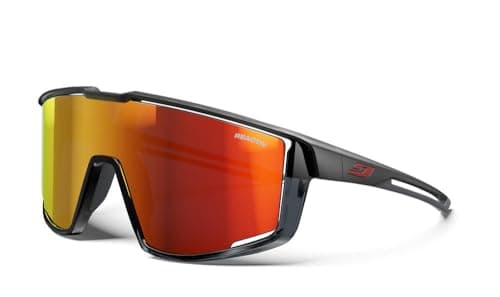
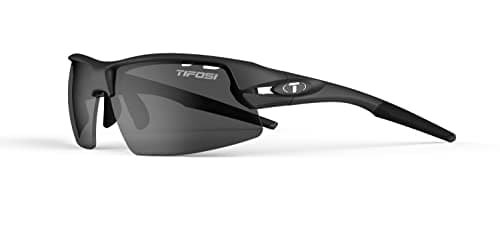
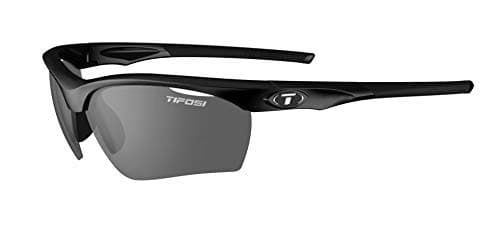
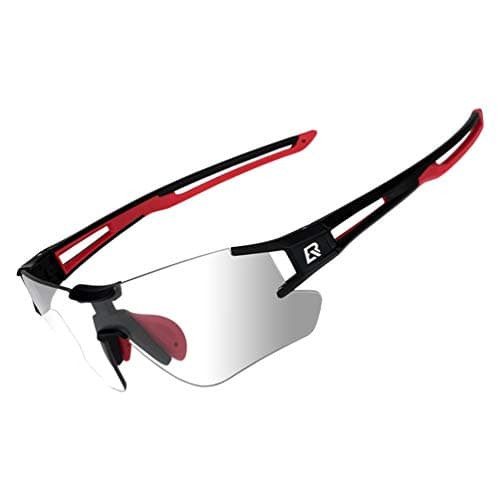
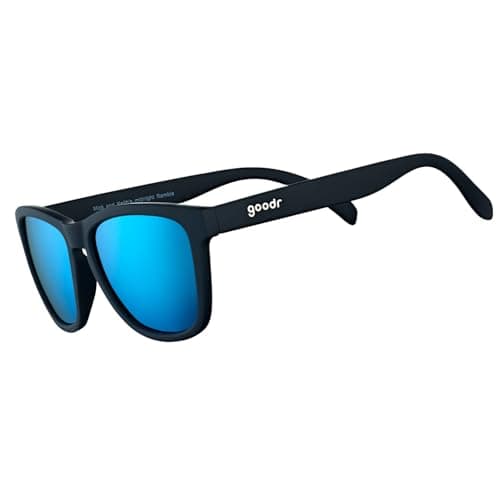
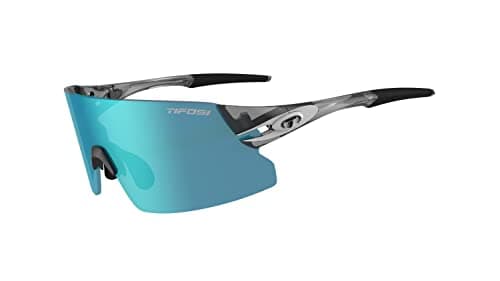
Buy an adaptive lens rather than a dark one, and skip polarized if your home course has trees. The Tifosi Rail XC is the pick for most players because its interchange set covers a bright open fairway, mixed light and a dusk round on one frame, and none of its three lenses is polarized. The Julbo Fury is the one-lens version of the same idea if you would rather not carry spares. There are polarized picks below too — they belong to open, water-lined courses, not to a technical wooded layout.
Disc golf is treated as a niche by nearly every eyewear buying guide, and it stopped being one some time ago. UDisc's 2026 Disc Golf Growth Report counts 17,287 courses across 99 countries, 21.2 million rounds recorded through its app in 2025, roughly three new courses opening per day, and participation up 86% since 2020. Zenni now markets itself as the official eyewear of the Disc Golf Pro Tour. The category is real. The advice mostly is not, because it gets copied over from cycling or running, and disc golf asks for something different in three specific ways.
1. The light changes hole to hole, and that is the whole problem
Almost every other sport on this site happens under one lighting condition. A road ride is bright or it is overcast. A round of ball golf is played across open, mown ground. Disc golf is not like that: you tee off in full sun on an open fairway, walk 200 feet into a wooded corridor where the canopy takes several stops of light out of the sky, throw an upshot in deep shade, and putt back out in the open.
A fixed dark tint is correct for exactly half of that round. Under the canopy it is genuinely unhelpful — you end up pushing the glasses onto your forehead to read a lie, which is how most people lose a pair. Tifosi's own disc golf lens guidance makes the same point and recommends its Fototec photochromic lens for wooded courses, because it "adjusts as light changes" when a round "moves from bright fairways to shaded gaps."
There are only two honest fixes. A photochromic lens darkens and clears on its own, so one pair covers the whole course. An interchangeable set gives you a bright-sun lens, a mixed-light lens and a clear lens, and you choose before you tee off. The photochromic route is less to think about; the interchange route gives you a deeper dark end and a genuinely clear lens, neither of which a photochromic reaches.
Both share one honest limitation that no brand advertises: photochromic lenses transition slowly — slower again in the cold — so a lens that has been sitting in full sun on the tee is still dark for the first few seconds under the canopy. The mechanism, and how wide each range actually is, is in best photochromic sunglasses, and the head-to-head with polarization is in polarized vs photochromic.
2. You are tracking a small object at distance, which is contrast, not darkness
A disc at 300 feet is a thin edge-on sliver against either a bright sky or a busy green-brown canopy. Losing it for two seconds at the apex is the difference between walking to your disc and walking a grid.
That is a contrast problem, and darkness does not solve contrast problems. A flat dark gray lens dims everything by the same amount, which keeps colors honest but does nothing to separate a white or orange disc from the background behind it. Rose, red, amber and copper-based tints work by knocking down part of the green-blue middle of the spectrum, which pushes warm objects forward against foliage and sky. Tifosi frames the same idea around course contours and tracking. The full tint logic, organized by background rather than by sport, is in sunglasses lens colors explained.
Frame geometry matters here too, for the same reason it does in baseball. On a hyzer flip or a big anhyzer you follow the disc up, often above the tree line, and a thick top rim then sits exactly in the flight path. A half-frame shield or a thin-rimmed single lens keeps that sightline open; a chunky lifestyle frame with a heavy brow does not. We made the same argument at more length in best sunglasses for baseball.
3. Polarized: right on open water-lined courses, wrong in the woods
Polarization is not a general upgrade, and disc golf is one of the clearest cases of that. A polarizing filter removes horizontally aligned reflected light — the Cleveland Clinic explains the mechanism — which is exactly what you want on a bright open layout with a pond in play, and exactly what you do not want under a canopy.
Tifosi puts it plainly in its disc golf guidance: polarized is helpful in bright, reflective conditions but may not suit technical wooded play, where terrain detail needs to stay clear. In the shade you are reading roots, rocks, leaf litter and a sloping lie, and some of the surface reflections a polarizer strips out are the cues your eyes use to judge that texture.
There is a second reason that is specific to this sport and almost never mentioned: you keep score on a phone.More than two million disc golfers use UDisc to find courses and score rounds, which means most players look at an LCD screen on every single hole. A polarized lens dims an LCD and, depending on the screen's own polarization axis and how you hold it, can black it out or show rainbow patterning at certain angles. That is a small irritation eighteen times a round. What is actually happening, and the workarounds, are in do polarized sunglasses block screens.
So the rule is not "never polarized." It is: open, bright, water in play, and you keep score on a card — take polarized. Wooded, technical, and you score on your phone — take a non-polarized adaptive lens. If your courses are a mix, non-polarized is the safer default, which is why our top pick is one.
4. The frame has to survive the reach-back
A backhand drive is a violent rotational movement that ends with your head snapping through and a hard follow-through. Then you walk, bend to pick up a disc, crouch to read a lie, and do it again. A frame that creeps down your nose on a warm day will do it at the worst moment.
Tifosi's guidance is that a disc golf frame should feel secure when you walk, bend and throw, with grip at the nose or temples. That matches what we recommend everywhere on this site: the material at the contact points decides retention far more than the shape does. Hydrophilic rubber that gets tackier as it dampens beats smooth plastic that gets slicker, and both beat a metal frame with hard pads. If you already own a pair that slides, the fixes are in how to stop sunglasses slipping — silicone temple sleeves cost almost nothing and solve most of it.
Weight is the other half. You are wearing these for two to three hours and several miles of walking, not for a 40-minute session on a court. Sport frames in the 22–32 gram range disappear; a heavy acetate lifestyle frame starts pressing on the bridge by the back nine.
5. You will scratch or lose a pair in the woods, so price the risk in
Discs go into brush, and so do the people looking for them. Between branches, thorns, mud and the pair you put on top of your bag and forgot about, disc golf is harder on eyewear than any court sport. That is a real argument against buying at the top of the market for a first pair.
There are two sensible ways to handle it. Buy a frame with replaceable lenses, so a scratch is a lens purchase rather than a new pair. Or buy at a price where losing them is annoying rather than painful — that field is ranked in best cheap polarized sunglasses. Either is defensible. Buying a premium fixed-lens pair and taking it into a wooded course is the option that ends badly.
6. Dusk rounds change the answer entirely
Disc golf gets played until it is genuinely too dark to see, far more than most sports, and the last two holes are often played in light where any tint is a liability. This is where an interchange set quietly earns its price: the clear lens in the box is not a tint at all, it is branch protection for the part of the round where you cannot see branches.
Be honest with yourself about whether you will carry the spare lenses. If the case is going to live in the car, a wide-range photochromic is the better buy, because its clear end is at least with you.
How we ranked these
Changing-light range first, because that is the sport's defining condition. Then contrast and sightline for tracking a disc, then retention and weight over a three-mile walk, then how replaceable or losable the pair is. Every pick is UV400 — the American Optometric Association recommends blocking 100% of UVA and UVB, and a full round is a long time outdoors. Scores come from the rubric on how we rate: judgments compiled from published specifications, not lab measurements. We do not run a lab, and we have not tested a pair on a course.