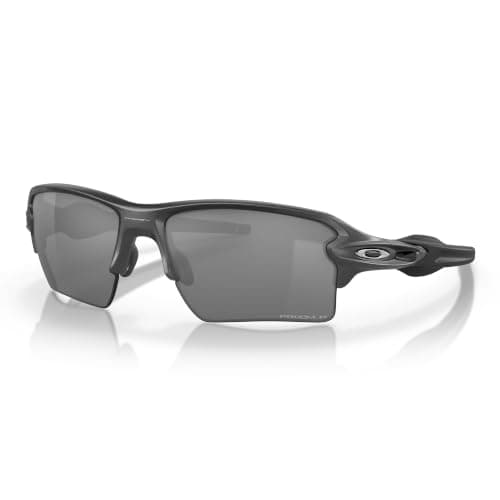
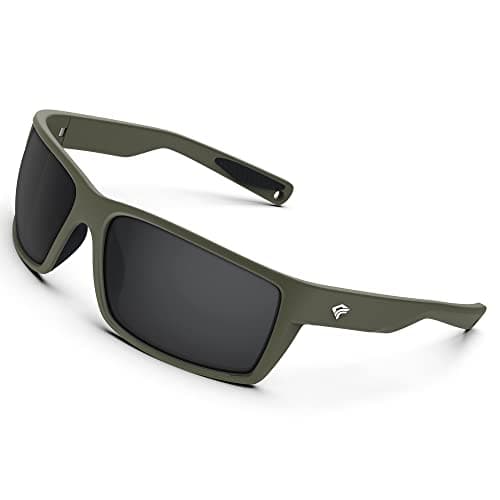
For most people who work outdoors, the TOREGE flexible-frame polarized is the pick, and the reason is unglamorous: it is polarized, it is UV400, and the frame bends instead of snapping when you kneel on it. Buy two. If you want a step up in finish without changing the math, the Tifosi Swank XL Polarized is a wider fit with a grip coating that holds on a sweating face. The Oakley Flak 2.0 XL Polarized is the only buy-once option here and the only one that genuinely earns its price, because the lenses swap and the frame survives years — but it is also the only pair on this page that will actually hurt to lose off a roof.
Nearly every sunglasses roundup is written for recreation: a weekend, a round of golf, a day on the boat. Working outside is a different specification. The exposure is cumulative and unavoidable rather than chosen, the pair gets dropped on concrete and sat on in a truck, it has to coexist with a hard hat and a dust mask, and the real failure mode is not optical - it is that you leave them on a tailgate in March and never see them again.
Start here: these are sunglasses, not safety glasses
Before the picks, the thing that matters most. If your work exposes you to flying particles, molten metal or chemical splash, sunglasses are not the right equipment and no amount of lens quality changes that. OSHA's eye and face protection standard, 29 CFR 1910.133, requires appropriate protection where workers are exposed to eye or face hazards, requires that protectors meet ANSI/ISEA Z87.1-2010, ANSI Z87.1-2003 or ANSI Z87.1-1989 (R-1998), and requires side protection where there is a hazard from flying objects.
None of the picks on this page is ANSI Z87.1 rated, and we are not going to imply otherwise to sell a frame. They are sunglasses for outdoor work where the hazard is sun rather than impact - landscaping, agriculture, surveying, utilities, delivery, groundskeeping, coaching, site supervision. If you need impact protection, buy Z87.1-stamped safety eyewear with side protection in a tinted version, and treat the two categories as separate purchases. We laid out the differences in sunglasses vs glasses, goggles and safety glasses.
What an eight-hour outdoor day actually asks for
We ranked against six requirements, in this order. The first two are the ones recreational roundups never weigh properly.
- Replacement cost, treated as a spec. A pair on a job site has a measurable half-life. Scratched on concrete, sat on in a truck seat, left on a tailgate, crushed in a tool bag. The correct response is not to buy a tougher expensive pair - it is to buy a pair whose loss is an annoyance, and to own a spare. Everything else on this list is subordinate to this.
- UV protection you can verify, because the exposure is cumulative. The CDC puts peak UV between 10 a.m. and 4 p.m. daylight saving time - which is the working day - and is explicit that UV reaches you on cloudy and cool days and reflects off water, cement, sand and snow. A concrete slab or a sand lot is a reflector you stand on for eight hours. The American Optometric Association recommends 99-100% UVA and UVB blocking regardless of price, so UV400 is a hard floor, not a feature.
- Coverage, including from below.The CDC's own sunglasses line is to "wear sunglasses that wrap around and block both UVA and UVB rays". On a site, the reflected light coming up off pale ground is as much of the problem as the sun overhead, and a wrap addresses both.
- Retention on a sweating face, under a hat. Grip material on the nose and temples is the difference between a pair you wear and a pair pushed up on your forehead, which is where pairs go to die. A hard hat brim adds a second constraint: thick temple arms and a hard hat suspension fight each other.
- A polarized lens, for the reflective surfaces. Wet pavement, windshields, standing water, sheet metal, glass. Polarization removes that reflection rather than dimming it, per the Cleveland Clinic. The exception is anyone reading LCD screens outdoors - a tablet, a total station, a machine display - where a polarized lens can black the screen out at certain head angles; see do polarized sunglasses block screens.
- A tint you can wear from 7 a.m. to 5 p.m. A very dark lens is comfortable at noon and a liability at the start and end of the shift. Mid-darkness brown or gray does the whole day; save the dark mirror for the pair in the truck.
| Job-site problem | What fixes it | What does not |
|---|
| You destroy a pair every few months | A cheap polarized pair, bought in twos | A tougher premium frame |
| Eight hours of UV, cloudy days included | UV400 or 100% UV, stated on the listing | A dark unrated lens |
| Glare up off concrete, water, sheet metal | A polarized lens plus a wrap | A darker non-polarized tint |
| They slide off when you sweat | Rubber or hydrophilic grip on nose and temples | Tightening the fit until it aches |
| They fight your hard hat | Thin temple arms, and a retainer | Pushing them onto the brim |
| Flying particles, grinding, chipping | ANSI Z87.1 safety eyewear with side protection | Any pair on this page |
The short answer
Quick picks
#ad · Live prices from the Amazon Product API, as of October 31, 2026. Where we have no verified live price, we show none — we would rather leave a gap than print a number that has rotted.
In detail
The picks, in full
A sport pair that survives being sat on
TOREGE Polarized Sport (Flexible Frame)
Flexible framePolarizedUV400Sport wrap
The bendy TOREGE — a polarized sport wrap you would have to work hard to break.
- Glare control
- 7
- Optics
- 6
- Fit & coverage
- 8
- Durability
- 6
- Value
- 9
Pros
- +The frame flexes and returns instead of snapping, which is the failure mode that kills cheap sport frames
- +Polarized and UV400, so glare and UV are genuinely handled
- +Light and grippy enough for running, riding and general outdoor use
Cons
- −Flexible frames feel less precisely located on your face than a rigid sport shield
- −Budget coatings scratch; the pouch is not optional
Don't buy this if…
…you want optical precision. This is a survive-anything frame with a competent lens, not a lens showcase.
Budget sport wrap with real glare control
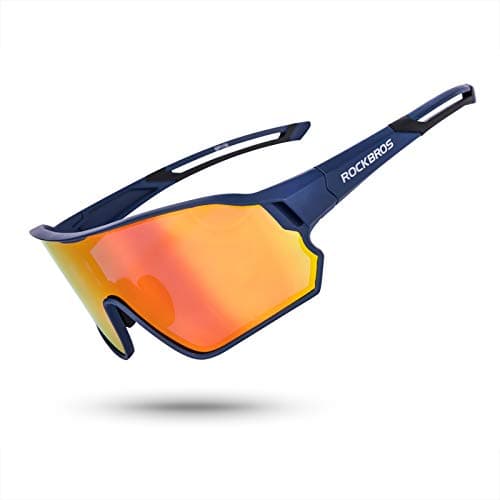
ROCKBROS Polarized Sport
PolarizedUV400Sport wrapLightweight frame
ROCKBROS's polarized sport wrap — the glare-cutting sibling to its photochromic lens.
- Glare control
- 8
- Optics
- 6
- Fit & coverage
- 8
- Durability
- 6
- Value
- 9
Pros
- +Polarized rather than photochromic, so it is the better ROCKBROS for wet roads, water and driving
- +Wrap shape controls the side light that a flat lifestyle lens lets straight in
- +Priced where losing a pair on a ride is annoying rather than painful
Cons
- −Polarization is the wrong call for reading a bike computer — the screen dims at some angles
- −Budget hinges and coatings; this is a season-or-two frame
Don't buy this if…
…your main use is cycling with a head unit. Take the photochromic version instead — it keeps the screen readable and handles changing light.
Wider faces on a budget
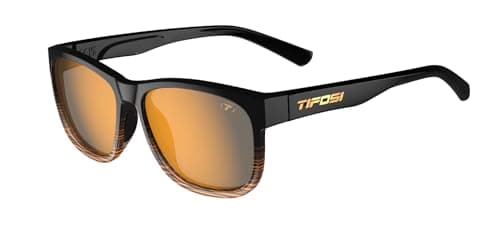
Tifosi Swank XL (Brown Polarized)
Injected polarized lensXL sizingBrown contrast tintUV400 polycarbonate
A genuinely polarized Tifosi in the frame built for wider faces — the answer when the standard Swank pinches and you still want glare control.
- Glare control
- 8
- Optics
- 7
- Fit & coverage
- 8
- Durability
- 7
- Value
- 9
Pros
- +Solves two problems at once: the standard Swank is too narrow for a lot of faces, and the standard lens is not polarized
- +The brown polarized tint lifts contrast on grass and water more than a neutral smoke lens does
- +Tifosi builds the polarization in as an injected layer rather than a surface coating, so it is the same lens construction as the rest of its polarized range and cannot rub off
Cons
- −Only a handful of XL colorways carry the polarized lens and the in-stock set moves around — check the colorway line says polarized rather than assuming the frame color you want has it
- −A brown tint shifts colors warm, which some people dislike for driving at dusk
- −Still a lifestyle shape: side light gets in, and it is not a substitute for a wrap
Don't buy this if…
…the standard Swank already fits you. The XL is a width fix, and buying up a size you do not need just makes the frame slide.
A step up from budget without Costa money
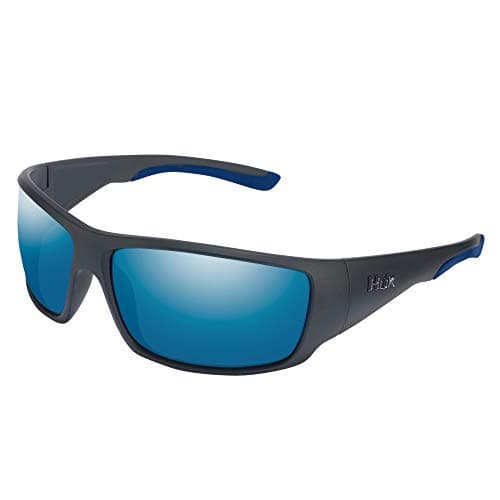
Huk Spearpoint (Polarized)
PolarizedMirror coatingPerformance frameUV400
A capable polarized fishing wrap from a fishing-apparel brand, at a mid price.
- Glare control
- 8
- Optics
- 7
- Fit & coverage
- 8
- Durability
- 7
- Value
- 8
Pros
- +Sits in the gap between $25 budget wraps and $200 Costas — polarized, mirrored, and built for water
- +Lighter and more wrap-shaped than a lifestyle frame, so side glare is controlled
- +Huk knows the fishing customer; the fit and grip are tuned for it
Cons
- −Lens contrast doesn't match Costa's 580 or Bajío's LAPIS glass for pulling fish out of surface glare
- −Coatings are the first thing to wear at this price point
Don't buy this if…
…you sight-fish seriously and can stretch the budget — the premium fishing lenses genuinely see more, and that's the whole reason to spend up.
Frame quality on a budget-fishing spend
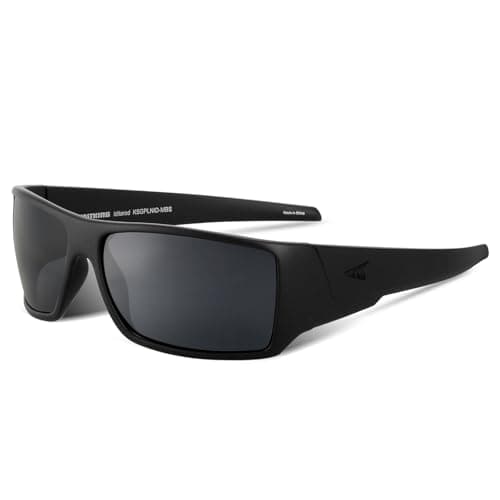
KastKing Iditarod Polarized
Grilamid framePolarized TAC lensUV400Sport wrap
A Grilamid-framed polarized wrap at a price that belongs two tiers higher.
- Glare control
- 8
- Optics
- 6
- Fit & coverage
- 8
- Durability
- 7
- Value
- 10
Pros
- +Grilamid is the frame material premium sport brands use, and finding it at this price is genuinely unusual
- +Polarized wrap coverage that seals out the side light a flat frame lets straight in
- +From a tackle brand, so the design assumptions are a boat deck rather than a sidewalk
Cons
- −A TAC film-laminate lens is optically a step below the molded polycarbonate in premium fishing glasses
- −No contrast tuning — it removes glare but does not lift fish out of the water the way a 580-class lens does
Don't buy this if…
…you sight-fish seriously. The frame punches above its price; the lens is honest budget, and the lens is what a sight-fisher is buying.
A polarized lens in a true sport frame
Oakley Flak 2.0 XL (Prizm Polarized)
Prizm Black PolarizedOO9188 Flak 2.0 XLXL lens coverageSwappable lenses
The polarized version of the sport frame runners already know — and the one Oakley lens list that actually says polarized.
- Glare control
- 9
- Optics
- 9
- Fit & coverage
- 8
- Durability
- 9
- Value
- 4
Pros
- +Polarization and Prizm contrast tuning in one lens, in a half-frame sport shape that stays out of your sightline
- +XL lens coverage and Oakley's frame build are the two things this money genuinely buys
- +Lenses are swappable, so a dark polarized lens is not a one-way decision about every run you will do in this frame
Cons
- −A very large premium over the non-polarized Prizm Flak for a filter a $25 lens also has
- −Oakley leaves most of its sport lenses non-polarized on purpose — buying the polarized one means opting into dimmed watch and computer screens
- −Half-frame design gives less bottom coverage than a full shield in low sun
Don't buy this if…
…the pair is for running and nothing else. Nothing here makes you faster, and the glare control in a $30 goodr is the same physics. Buy this because you want the frame.
Who each pick is for, and what is wrong with it
- TOREGE Polarized Sport (Flexible Frame)— the default, and the pick that best matches how sunglasses actually die at work. The flexible frame is the whole argument: it deforms and returns instead of snapping when it is knelt on or sat on. Polarized, UV400, sport wrap. Honest cons: budget coatings scratch if you clean them with a shirt, the finish is unremarkable, and the one-size fit will not suit a very wide face.
- ROCKBROS Polarized Sport— the alternative budget wrap, and the one to buy as your second pair in a different tint. Real glare control in a light sport frame at a price that makes a spare obvious. Honest cons: no adjustability, a frame that reads as cycling gear rather than workwear, and the same coating caveat as any pair at this price.
- Tifosi Swank XL (Brown Polarized)— the step up in finish, and the answer for a wider face. An injected polarized lens rather than a coating, a brown contrast tint that works at 7 a.m. and at noon, and Tifosi's hydrophilic grip, which gets stickier as you sweat rather than looser. Honest cons: a lifestyle shape means less coverage from below than a true wrap, and it costs enough that losing one stings.
- Huk Spearpoint (Polarized)— the mid-budget wrap with grip, borrowed from fishing where the sweat-and-glare problem is identical. Polarized with a mirror coating and a performance frame. Honest cons: fishing styling, and a mirror lens is the first thing to show scratches on a dusty site.
- KastKing Iditarod Polarized— the best frame material at the bottom of the price range: a Grilamid frame, which is the same family of nylon used in far more expensive sport eyewear, with a polarized TAC lens and UV400. The pick if you want budget money to buy durability rather than features. Honest cons: a TAC lens is a laminate and does not resolve like a premium polycarbonate, and the sport wrap is not a look everyone wants off the clock.
- Oakley Flak 2.0 XL (Prizm Polarized)— the buy-once option, and the only pick here that is genuinely worth its price over a decade: XL lens coverage, swappable lenses, a frame built to deform, grip that holds when wet, and a contrast tint on top of the polarizing filter. Honest cons:it is many times the price of everything above it, it is the one pair on this page you will mourn, and you must buy the listing that says Prizm Polarized — Prizm alone is a contrast tint, not a polarizing filter.
The two-pair strategy, and why it is not a cop-out
The single most useful recommendation on this page is to own two cheap pairs rather than one good one. It is not a budget compromise; it is the correct answer to the actual conditions.
A pair at work has a destruction rate, and that rate does not fall much when you spend more - a premium frame dropped lens-down on a concrete pour is just as scratched, and considerably more expensive. Owning two means you have a spare the day one goes missing rather than a week of squinting while you wait for a delivery, and it means you can carry two tints: a mid-darkness brown or gray for the full day, and a darker mirror for midsummer or for work on water, snow or white concrete. That is a better outcome than any single pair delivers at any price.
The exception is the person who genuinely does not lose things and has worn the same pair for five years. If that is you, buy the Flak and swap lenses. You know who you are, and you are rare.
Hard hats, retention and the tailgate problem
Three practical notes that no spec sheet covers.
Hard hat suspensions and thick temple arms fight each other. If the arms sit under the suspension band they lift the hat; if they sit over it they get pushed off your ears. Thinner arms win here, which is one of the few places where a sport-sunglass design is a disadvantage against a safety-glass design.
A retainer costs less than a sandwich and prevents most losses. The classic failure is pushing the pair up onto your forehead or hat brim when you go into shade and then bending over. A cord keeps them on your chest instead of under a wheel. It is the single highest return purchase on this page.
Clean them with water, not your shirt. Site dust is abrasive, and wiping it dry with a t-shirt is how a lens goes hazy in two weeks. Rinse first, then dry with something soft - the full method is in how to clean sunglasses, and it adds months to a cheap lens.
If you wear prescription glasses at work
Three routes, and the right one depends on the hazard. A polarized fit-over worn over your own glasses is the cheapest and gives you side coverage; a clip-on is lighter and less obtrusive under a hat; prescription sunglasses are the best experience and the worst value if you destroy pairs. We cover the decision in do fit-over sunglasses work and the options in sunglasses that fit over glasses and prescription polarized sunglasses.
One caveat specific to work: if your job requires impact protection, a fit-over or clip-on over ordinary prescription glasses does not deliver it. Prescription safety eyewear in a Z87.1-rated frame is the route, and it is a conversation with your employer rather than a shopping decision.
What about working outside in winter?
Do not stop wearing them. The CDC is explicit that UV reaches you on cloudy and cool days and that snow reflects it, which makes a bright winter site one of the higher-exposure environments of the year with none of the heat that reminds you to protect yourself. The practical change is tint, not darkness: a mid-darkness brown or copper handles low winter sun that sits in your eyes most of the day, where a very dark mirror leaves you unable to read ground detail by mid-afternoon. If the site is snow-covered, the brightest case of all is covered in best sunglasses for snow and skiing.
If you drive for part of the day
A lot of outdoor work involves a vehicle, and the two uses pull in slightly different directions: a wrap that is right on a site can crop the periphery you use for mirror checks, and a polarized lens can blank an LCD dash. If more than half your shift is behind a wheel, start at best sunglasses for driving instead, and best sunglasses for truck drivers is the version written for a full day in a cab.
Buying for a work day, in five questions
Is there an impact hazard?
Yes → you need ANSI Z87.1 safety eyewear with side protection, not sunglasses. Buy that first and treat shade as a separate problem.
How many pairs did you lose or break last year?
Two or more → buy the cheap pick and buy two of them. Zero → the Flak is a rational purchase.
Do you wear a hard hat?
Then favor thinner temple arms, and buy a retainer in the same order.
Do you read a screen outdoors?
A tablet, a total station, a machine display → test polarization against it before committing, or keep a non-polarized pair for that task.
What is the ground like?
Pale concrete, sand, water or snow → take the wrap and a polarized lens; the reflected light from below is most of your exposure.
The cheap stuff that matters
Essentials under $40
The add-ons this page already told you to get. None of these is scored — our rubric measures glare control, optics, fit, durability and value, and four of those mean nothing for a cleaning cloth. So you get a reason and a live price instead of a number we'd have had to invent.
SMARTTOP
SMARTTOP Silicone Eyeglass Ear Grips (18 pairs)
Soft sleeves that slide onto the temple arms so they grip skin instead of sliding on it. The cheapest real fix for a frame that is otherwise the right size.
Chums
Chums Original Cotton Retainer
The plain cotton eyewear keeper. Adjustable, washable, and the version most people mean when they say Croakies. Colorways vary on the listing.
Generic
Floating Sunglasses Straps for Water (4-pack)
A buoyant strap for boats, kayaks and wading. Note what this is: the STRAP provides the flotation. Do not assume any pair floats on its own.
#ad · Live prices as of October 31, 2026, hidden when our data goes stale. We may earn a commission, at no cost to you. How this works.
How we picked
We don't run a testing lab
We compile each pair's published specifications — lens material, polarization, coating, frame material, coverage, UV rating and price — normalize them, and score each against a published rubric. The scores are judgments from documented research; they are notmeasurements we took, because we don't own a lab and we're not going to pretend we do. Pairs we claim to have lab-tested: 0.
Questions
Frequently asked
What sunglasses are best for working outside all day?+
A polarized UV400 wrap that you can afford to replace, bought in pairs rather than singly. On a job site the destruction rate makes replacement cost the deciding spec, not optics - the flexible-frame TOREGE is the pick here for exactly that reason. The one pair that justifies real money is the Oakley Flak 2.0 XL Polarized, because the lenses swap and the frame lasts years.
Are sunglasses enough eye protection for outdoor work?+
For sun, yes. For impact, no. OSHA 29 CFR 1910.133 requires eye protection meeting ANSI Z87.1 where workers are exposed to eye hazards, with side protection where flying objects are a risk, and none of the sunglasses on this page carries that rating. If there is grinding, chipping, cutting or chemical splash in your day, buy tinted Z87.1-rated safety eyewear instead - the difference is explained in
sunglasses vs glasses, goggles and safety glasses.
Do I need polarized sunglasses for working outside?+
For most outdoor work, yes — wet pavement, standing water, vehicle glass and sheet metal are all reflected-glare surfaces, and a polarizing filter removes that reflection rather than dimming it. The exception is anyone reading an LCD screen outdoors, where a polarized lens can black the display out at certain head angles. Test it against your own equipment before committing.
How much should I spend on work sunglasses?+
Less than you think, and twice. The sensible plan for most outdoor workers is two inexpensive polarized pairs in different tints rather than one premium pair, because a job site destroys eyewear at a rate that does not fall when you spend more. Premium is only rational if you have genuinely owned the same pair for years.
What lens tint is best for all-day outdoor work?+
Mid-darkness brown, copper or gray. Brown and copper lift contrast in low morning and evening sun, which is when a very dark lens becomes a liability; gray keeps colors accurate. Save dark mirrors for midsummer or for work on water, snow or white concrete. Full breakdown in
sunglasses lens colors explained.
Do you still need sunglasses outside on cloudy days?+
Yes. The CDC states plainly that the sun's UV rays reach you on cloudy and cool days, and that UV reflects off water, cement, sand and snow — a pale concrete slab is a reflector you stand on all day. Cumulative exposure is the risk for outdoor workers, and the days that do not feel bright are the ones people skip.
Receipts
Sources
We do not run a testing lab, and we do not pretend to. Where a spec or measurement came from a manufacturer or a third party, we name and link it. Where we could not verify something, we say so on the page rather than quietly leaving it out. Read our full method.