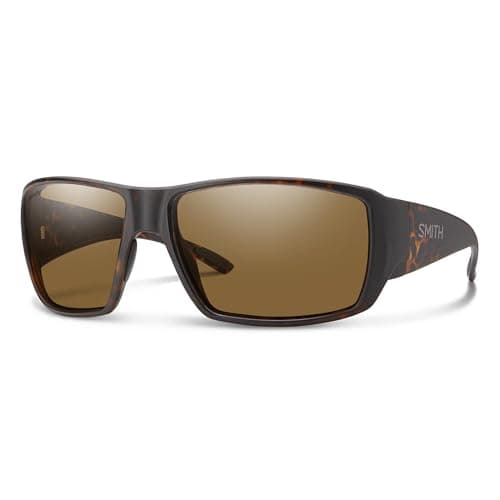
Buy Smith if you want coverage and a warranty: Smith publishes a lifetime defect warranty on its sunglasses and builds the widest wraps in the premium tier, and the Guide's Choice is the best purpose-built fishing frame of the two. Buy Maui Jim if the lens itself is the point: its published Abbe values and mineral-glass options are the clarity argument, and every pair it sells is polarized, so there is no wrong listing to click. The single spec that decides it for most people is not optical at all - it is that Smith sells the same frame polarized and non-polarized, and Maui Jim does not.
These two brands get compared because they look like the same purchase - two premium American eyewear names, both selling a contrast-enhanced lens at a price that makes you think about it. They are not the same purchase. They are solving different halves of the problem, and once you see which half you care about the decision stops being close.
The short version
| Maui Jim | Smith |
|---|
| Lens idea | PolarizedPlus2 - polarizing film plus a rare-earth contrast blend | ChromaPop - filters the blue/green and green/red wavelength crossovers |
| Always polarized? | Yes, every pair, per Maui Jim's own support documentation | No - ChromaPop is sold both polarized and plain, so read the listing |
| Published tint data | Named tints; VLT not published per tint | VLT published per tint, from 10% (Black) to 65% (Low Light Amber) |
| Lens materials | SuperThin Glass (Abbe 58), MauiBrilliant, MauiPure, MauiPure LT, polycarbonate (Abbe 30) | Carbonic (lightweight, impact-resistant), Techlite glass, glass |
| Coverage | Lifestyle and moderate wrap shapes | Up to goggle-scale shields; 8-base fishing wraps |
| Warranty on sunglasses | Two years, original purchaser, authorized retailer | Lifetime of the product against manufacturer defects |
The lenses are answering different questions
Maui Jim's claim is clarity. Per SportRx's Maui Jim lens guide, PolarizedPlus2 cuts 99.9% of glare, blocks 100% of UV with HEV protection, and gets its contrast from a patented blend of three rare earth elements. The numbers that matter, though, are the material ones: SuperThin Glass is published at an Abbe value of 58 and described as 20% thinner and 32% lighter than standard laminated glass, against polycarbonate at Abbe 30, with Maui Jim's proprietary plastics in the 43-56 range. Abbe value measures how little a lens disperses light into color fringing, so a high number is a direct claim about optical quality. That is the brand's whole argument, and it is a real one.
Smith's claim is color separation. Smith's own technology page states the premise directly: "Normally the eye has trouble distinguishing colors where the blue/green and the green/red wavelengths cross over," and ChromaPop "filters these specific crossovers for greater definition, natural color, and clarity." That is a narrower and more testable claim than "better optics" - it says the lens removes specific wavelengths where your eye gets confused, which is what makes a root register against dirt or a fish against a bottom.
Neither claim beats the other on paper, and we have not measured either - no one should tell you they have unless they ran a lab. What we can compare is the published data, and here Smith is more forthcoming in one specific way: it publishes a VLT figure for every tint - Black 10%, Green Mirror 12%, Gray Green 12%, Platinum 12%, Red Mirror 15%, Bronze Mirror 15%, Ignitor 32%, Contrast Rose 50%, Low Light Amber 65%. Maui Jim names its tints (Neutral Grey, HCL Bronze, Maui Rose, Maui HT, plus the Blue Hawaii, MAUIGreen, Hawaii Lava and MAUI Sunrise mirrors) but does not publish VLT per tint. If you are the kind of buyer who wants to match a lens to a light level by number, Smith lets you and Maui Jim asks you to trust the description.
The polarization difference is the decision for most people
This is where the two brands genuinely diverge, and it cuts both ways.
Maui Jim's support documentation states that all its sunglasses are polarized, with no model excepted. You cannot buy the wrong one. Smith sells ChromaPop both ways, which means you have to read the lens line - and also means you can choose a non-polarized premium lens, which matters more than it sounds. Polarized lenses can dim LCD dashboards, chartplotters and bike computers, and plenty of cyclists and golfers avoid them deliberately; Tifosi publishes the same caveat in its lens guide. Smith will sell you contrast tuning without the filter. Maui Jim will not.
So: if you want certainty and your use is water, driving or snow, Maui Jim's policy is an advantage worth paying for. If you want a premium contrast lens for a bike, a golf course or anywhere you read a screen, Smith is the only one of the two that can sell it to you. We lay out the full yes/no in are all Maui Jim sunglasses polarized.
Coverage: Smith wins this one outright
Smith builds bigger. The Wildcat is close to goggle scale with a removable frame, and the Guide's Choice is an 8-base fishing wrap with megol nose and temple pads that tack up as they get wet, per Feather-Craft's product page. Maui Jim's range runs from lifestyle shapes to moderate wraps; nothing in it is trying to be a goggle. If your problem is light and debris coming in around the lens - mountain biking, poling a flat, a sea kayak, high-speed anything - Smith has frames for it and Maui Jim mostly does not. If your problem is wanting a beautiful pair of sunglasses with an exceptional lens, the reverse is true.
Worth noting what the CDC actually advises on this point: sunglasses that "wrap around and block both UVA and UVB rays." Coverage is a protection spec, not only a performance one.
Warranty: Smith wins this one too, on paper
Smith's warranty policy covers sunglasses and goggles "for the lifetime of the product against manufacturer's defects," with prescription eyewear at two years. Maui Jim's published policy is two years from purchase, for the original purchaser, on pairs bought from an authorized retailer - and Maui Jim states that it offers no coverage beyond that.
Read the exclusions before you weigh this too heavily, because they are nearly identical and they are the part that bites. Smith excludes product "lost, stolen, dropped, sat on, stepped on" and damage from "accident, improper care, negligence, normal wear and tear." Maui Jim excludes normal wear such as lens scratching, and accidental breakage. Neither is an insurance policy, and the way premium sunglasses actually die - scratched, sat on, lost - is excluded by both. "Lifetime" here means lifetime against defects, which is a narrower promise than it reads.
Who each pick is for
- Smith Guide's Choice (ChromaPop Polarized) — the best of the two for water. An 8-base wrap built as a fishing frame rather than a lifestyle shape with a polarized lens dropped in, with megol pads that grip harder as they wet and an anti-reflective coating that kills the ghost image off the back of a dark lens. Honest cons: it is priced with Maui Jim and Costa, so you are paying premium-brand money, and the aggressive wrap looks like what it is anywhere other than a boat. Do not buy it if you want one pair that also works with a jacket in town.
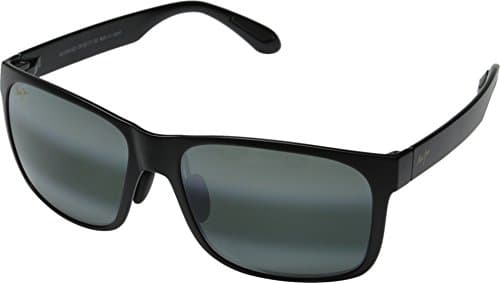
- Maui Jim Red Sands — the clarity pick. A MauiPure lens in a wrapped nylon frame: the brand at its most convincing, and the pair that makes the Abbe-value argument in your hand rather than on a spec sheet. Honest cons: the most expensive pair on this site, and like every polarized lens it dims phone and dashboard screens. Do not buy it if you lose sunglasses - the glare math that matters to most buyers is largely there on pairs costing a fifth as much.
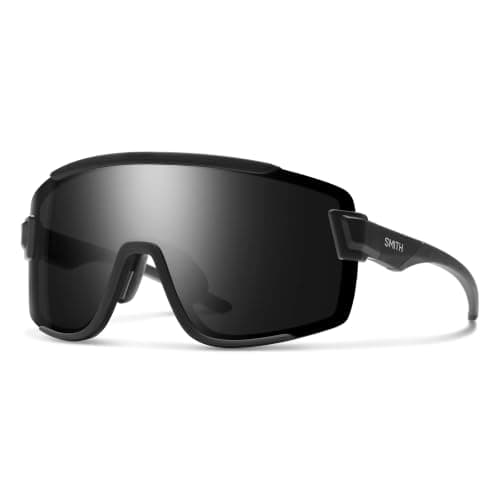
- Smith Wildcat (ChromaPop) — the coverage pick.Goggle-scale coverage with a removable frame, and the clearest illustration of what Smith does that Maui Jim does not. ChromaPop's contrast tuning genuinely helps root and rock definition register earlier in dappled light. Honest cons: the sheer size is a lot of eyewear anywhere but a trail, and a large lens fogs more readily on slow technical climbs. Do not buy it if you ride mostly road or want one everyday pair. Note this is the plain ChromaPop listing, not the polarized one - which is the whole point of the comparison.
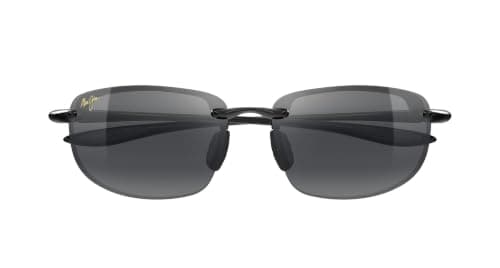
- Maui Jim Hookipa — the everyday Maui Jim. Medium fit, classic shape, same lens platform as the Red Sands with less coverage. The sensible choice if you want the lens and do not want a sport wrap. Honest cons: premium price for a lifestyle frame, and modest wrap means side-on sun gets past it. Do not buy it if you need a fishing or sport frame.
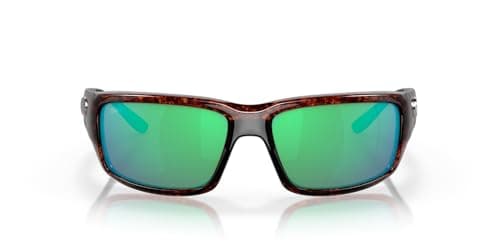
- Costa Fantail 580G (Glass) — the third option neither brand wants you to see.Included because "smith vs costa vs maui jim" is a real search and the honest answer is that Costa is the one of the three with a lens range built explicitly around water: the 580 filter cuts a band at 580nm to lift contrast, published at 99.9% polarization efficiency, with 580G published as 20% thinner and 22% lighter than other polarized glass. Honest cons: glass is noticeably heavier on a full day and shatters where polycarbonate flexes. Do not buy it if you fish from a moving boat in chop or keep your sunglasses loose in a bag. The full matchup is in Smith vs Costa.
Which one for fishing?
"Maui Jim vs Smith for fishing" is the most-searched version of this question and it has a clear answer: Smith, if you are buying one pair to fish in. The Guide's Choice is a purpose-built angling frame - 8-base wrap, megol grip, ChromaPop polarized - and Maui Jim's range does not contain a direct equivalent. Maui Jim will give you a cleaner lens in a less fishing-shaped frame, and on a boat deck the frame matters more than people expect, because side light and a frame walking down a sweating nose both cost you more than a point of optical clarity.
The caveat: if your fishing is sight-fishing in bright water and you want the best lens available rather than the best fishing frame, the conversation widens past both brands. We rank that field in the fishing sunglasses hub and settle the glass-versus-polycarbonate question in best glass lens sunglasses.
Which one for everyday wear?
Maui Jim, comfortably. Its lifestyle frames are better looking and better proportioned for a face that is not inside a helmet, the lens is the point, and the always-polarized policy means an everyday pair handles driving and water without you having checked a spec. Smith's everyday shapes exist but the brand's center of gravity is sport, and its best products look like sport products.
If the Maui Jim price is the obstacle - and for most people it is - the honest comparison is not Smith, it is the field of cheaper mineral-glass and premium-polarized options we rank in the best Maui Jim alternatives and best polarized lenses.
Which one for cycling, skiing and snow?
Smith, and not close. Coverage, a plain non-polarized ChromaPop option for reading a head unit or a snow surface, published VLT figures so you can pick a lens for the light, and a brand whose goggle business means its sport frames are designed around helmets. Maui Jim is not competing here. The reasoning for avoiding polarization on a bike is in are polarized lenses good for cycling, and the snow case is in best sunglasses for snow and skiing.
Is either worth the money?
Both are genuinely premium products and both are many times the price of a competent polarized lens, so the answer depends entirely on hours of use. The thing neither brand is selling you is protection: UV blocking is the eye-health function, the American Optometric Association recommends 99-100% UVA and UVB at any price, and a twenty-dollar UV400 lens clears that bar. What you are paying for is clarity, contrast tuning, coverage, build and service. We make the general case both ways in are expensive sunglasses worth it, and the brand-level range reviews are in our Smith sunglasses review and our Maui Jim sunglasses review.