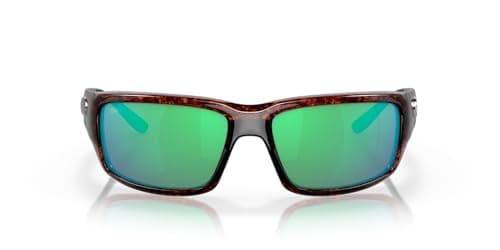
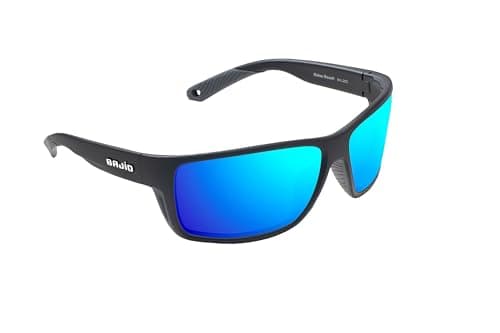
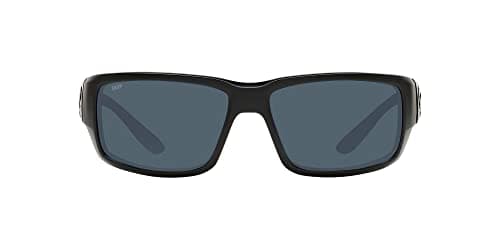
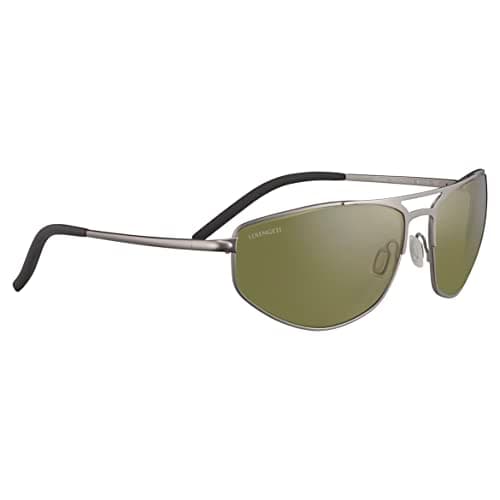
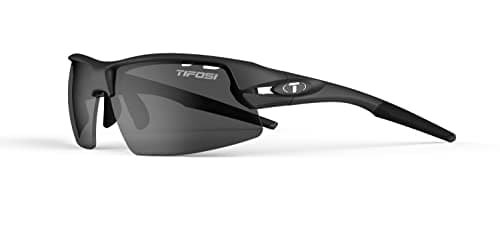
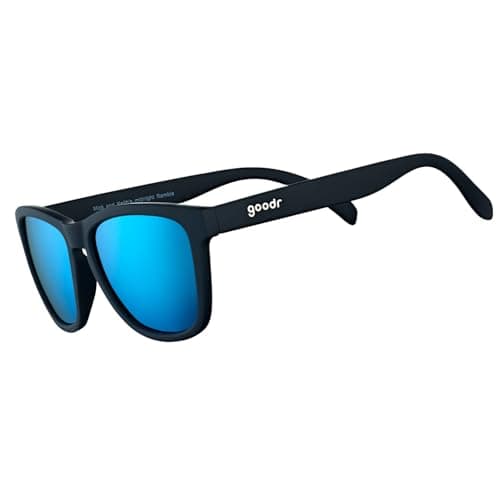
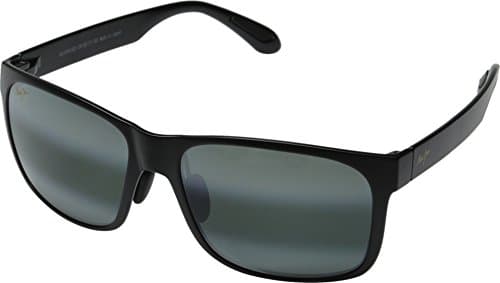
Maui Jim's PolarizedPlus2 is the best polarized lens sold, and Costa's 580G glass is the clearest. Neither is the lens most people should buy. The honest ranking below is a ranking of lenses, not of purchases — and if you are shopping rather than researching, the goodr OG at the bottom of it removes glare as completely as the pair at the top for roughly a tenth of the money.
That gap between "best lens" and "best buy" is the whole reason this page exists. Every brand markets its polarized lens as though the polarizing filter itself were the product. It is not. The filter is the most commoditized part of a modern lens, and it is the part where a budget pair and a premium pair genuinely do the same thing. What actually separates them is the material the filter is laminated into, the tint engineered around it, and the coatings on the outside — three variables the marketing bundles into one trademarked name.
This page unbundles them. If you want the field ranked as things to buy, with fit and price weighted in, that is our best polarized sunglasses roundup. This is the version for people who want to know what they are paying for.
1. The four variables that actually differ
Strip the trademarks away and every polarized lens on the market is a stack of four decisions. Understanding which of them a brand is charging you for is most of the buying problem solved.
The polarizing filter.A microscopic grid that blocks horizontally aligned reflected light — the Cleveland Clinic has the plain-English mechanism. Present in every lens here. Barely differentiated.
The lens material. Glass, polycarbonate, or one of the nylon-family plastics. This decides optical sharpness, weight, scratch behavior and whether the lens shatters or flexes. It is the single biggest driver of what you actually see.
The tint and its spectral tuning. Whether the lens dims everything equally or selectively filters certain wavelengths to lift contrast. This is where 580, PolarizedPlus2, LAPIS and Spectral Control live, and where the brands genuinely differ from each other.
The coatings. Anti-reflective on the back surface, hydrophobic and oleophobic on the front, plus whatever hardcoat is protecting the lot. Invisible on day one and the thing that decides whether the lens is still clear in year three.
2. The polarizer is the least differentiated part
This is the part the industry would rather you did not know. Both of the premium leaders publish essentially the same number: Costa states 99.9% polarization efficiency for its 580 lenses, and Maui Jim states that PolarizedPlus2 cuts 99.9% of glare. A competent $25 polarized lens is not far off either figure, because a polarizing film is a mature, cheap, well-understood component.
So if your entire requirement is "remove the glare off the water and off a wet road," you are done at the bottom of this list. Everything above it is buying you a better view of the scene that is left. That is a real thing to want — it is just not the thing the word "polarized" on the box is selling you.
The two caveats. First, polarization and UV protection are unrelated properties, and only one of them is a health question: the American Optometric Association recommends blocking 100% of UVA and UVB, and that standard is met at every price on this page and far below it. You never buy your way to better UV protection. Second, some cheap listings label a merely dark lens "polarized," which is a different problem from a weak polarizer — the vocabulary those listings use is decoded in what HD polarized really means, and the thirty-second test that catches a fake is in how to tell if sunglasses are polarized.
3. Material: the variable that changes the most and gets discussed the least
Optics people measure a material's tendency to split light into color fringes with its Abbe value— higher is cleaner. The published numbers are not close. Crown glass and CR-39 sit at about 58, Trivex at 43–44, and polycarbonate at 30, which that same reference calls polycarbonate's "primary optical limitation." Maui Jim publishes an Abbe value of 58 for its SuperThin Glass, and Serengeti's borosilicate mineral lens is quoted at the same 58.
In plain terms: a glass lens resolves fine detail more cleanly than a polycarbonate one, and the difference is largest at the edges of your field of view and on high-contrast boundaries — a horizon, a rod tip, a branch against the sky. This is the single largest optical difference between a $300 lens and a $30 one, and it is a property of the material rather than of the brand.
Glass charges for it in two currencies. It is heavier on the nose over a full day, and it shatters where polycarbonate flexes. Costa says as much in its own materials guidance: the 580P polycarbonate is the impact-resistant option and the one to choose "if you're wearing them for sports" . That is why a glass lens is right on a boat, in a car and on a dock, and wrong on a bike, a court or a trail, no matter how much better the optic is. The full argument is in best glass lens sunglasses.
The premium brands each sell a middle path. Costa's 580G glass is published as 20% thinner and 22% lighter than other polarized glass with mirrors encapsulated between the glass layers so they cannot be scratched off. Maui Jim's SuperThin Glass is published as 20% thinner and 32% lighter than standard laminated glass, with its MauiPure plastic described as the second lightest option and "almost as good" optically. Serengeti's mineral glass is likewise quoted as 20% thinner and lighter than standard glass. Those are all real engineering. None of them repeals the shatter problem.
4. Contrast tuning: the brand names, decoded
This is the layer the trademarks are actually protecting, and the one place where the premium lenses genuinely do different things from each other rather than doing the same thing better.
Costa 580. Named for the wavelength it targets: the lens filters light at 580 nanometers, described as the harshest yellow band, so that reds, greens and blues stand apart more clearly. It is tuned for water. It is why a Costa reads as a fishing lens even in a lifestyle frame.
Maui Jim PolarizedPlus2.Not a stronger polarizer — a stack. Maui Jim publishes it as the polarizing filter plus UV and HEV blue-light blocking plus a patented blend of three rare earth elements that lift reds, greens and blues, wrapped in a bi-gradient mirror and an anti-reflective treatment. It is the broadest tuning here: rather than optimizing for one environment, it tries to make everything look better. We take the range apart in Maui Jim lenses explained.
Bajío LAPIS. The specialist. Bajío publishes LAPIS as blocking 95% of blue light up to 440nm along with the majority of intense yellow at its 580nm peak — so it attacks the same yellow band Costa does and the short blue end that scatters into haze over bright water. If your one use is sight-fishing a bright flat, this is the most narrowly optimized lens on the page. See Costa vs Bajío for the head-to-head.
Serengeti Spectral Control (555nm). Tuned to 555 nanometers, the wavelength the human eye resolves most efficiently, and paired with a photochromic mineral lens. Serengeti publishes a transmission range of 8% to 21% as the lens darkens and clears — unusual, because polarized and photochromic in the same lens is rare. That combination is compared properly in polarized vs photochromic.
Oakley Prizm and Smith ChromaPop. Both are contrast-tuned tints, and both are most often sold non-polarized, because their core sports — cycling, mountain biking, golf — actively want the reflections a polarizer removes. Polarized variants of each exist and you have to buy the specific one. That is a common and expensive mix-up; the detail is in Oakley Prizm explained and our Smith review.
The honest limit on all of it: we cannot tell you which tuning is objectively best, and neither can anyone without a spectrophotometer and a controlled trial. What we can tell you is that these are real, published, differentiated engineering targets rather than paint, and that they point at different environments. Pick the one aimed at where you actually are.
5. Coatings: what decides whether the lens is still good in year three
Nobody shops on coatings and almost everybody is eventually annoyed by them. Three matter.
Anti-reflective on the back surfacekills the ghost image of light coming from behind you and bouncing off the inside of the lens into your eye — the reason a cheap dark lens can feel hazy in exactly the bright conditions it was bought for. Maui Jim lists an anti-reflective treatment as part of the PolarizedPlus2 stack; Serengeti's published coating list includes it too.
Hydrophobic and oleophobic coatings make water bead and fingerprints wipe off instead of smearing. Bajío and Serengeti both publish them. On the water this is not a luxury: it is the difference between a lens you can clear with a shirt and one that needs a proper cloth every ten minutes.
Hardcoats are where the two premium approaches diverge most usefully. Costa encapsulates its 580G mirrors betweenglass layers so the mirror cannot be worn off, and bonds a "C-WALL" molecular layer onto the 580P polycarbonate to make it more scratch-resistant than other polycarbonate. That is a genuine answer to polycarbonate's real weakness. It is also the part of a premium lens you can destroy yourself with a paper towel or a household glass cleaner, which is why our cleaning guide exists.
6. What "clearest" actually means
People searching for the clearest polarized sunglasses are usually describing one of three different complaints, and they have three different fixes.
"Things look slightly fringed or soft at the edges."That is chromatic aberration and it is an Abbe-value problem — a material issue. Glass or a high-Abbe plastic fixes it. Buying a more expensive polycarbonate lens does not.
"It feels hazy in bright light even though it is dark." That is usually back-surface reflection or a tired coating, not the tint. Anti-reflective coating fixes it, and no amount of extra darkness will.
"Colors look muddy or washed out."That is the tint, and it is the one the contrast-tuned lenses genuinely address — though a plain neutral gray is the most color-honest lens made and is the right answer for anyone who wants the world to look like itself, just dimmer. Which tint suits which conditions is in sunglasses lens colors explained.
7. Where the money stops buying anything
Our reading of the published specs is that the curve flattens hard in two places. The first is around the point where you get a genuinely polarized lens with real UV400 and a coating that is not going to craze in a season. The second is at glass: once you are in a well-made glass or high-Abbe lens with anti-reflective and hydrophobic coatings, the remaining differences between the premium programs are differences of tuning, which means they are differences of environment and taste, not of quality.
What the top of the market does buy that the bottom does not: edge-to-edge sharpness you notice on a horizon, coatings that survive years rather than seasons, frames engineered around the lens rather than the other way round, and in most cases a repairable product with replaceable parts. If you wear one pair every day for a decade, that is a defensible purchase. If you lose sunglasses, it is not, and we would rather say so — the longer version of that argument is in are expensive sunglasses worth it.
How we ranked these
Optical quality of the lens first (material and published Abbe value), then how specific and credible the spectral tuning is, then the coating package, then how well the lens suits a real use rather than a spec sheet. Price is deliberately last, because this page ranks lenses rather than purchases — that is what makes it different from the hub, and it is why the cheapest pick here finishes last on the list and is still the right buy for most readers.
Every claim above is a published manufacturer specification or a documented reference, named inline and listed at the bottom. Scores come from the rubric on how we rate: judgments compiled from published specifications, not lab measurements. We do not run a lab, we have not measured these lenses, and prices update automatically from the retailer rather than being typed in here.