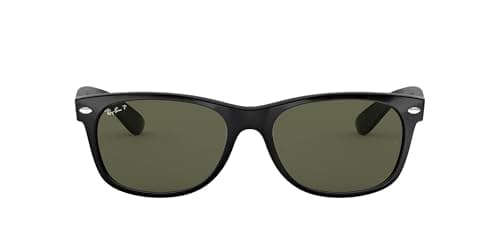
No, not by default - and this is the single most expensive misunderstanding in buying Ray-Bans. Polarization is an option on most Ray-Ban lens colors rather than a brand standard, so the same frame is sold both ways and the two are hard to tell apart in a shop. There is one reliable physical check: a polarized Ray-Ban carries a small "P" after the Ray-Ban logo on the right lens. If you want a polarized Ray-Ban, the New Wayfarer Polarized is the pick on this page; if you want a pair that is polarized no matter which listing you click, buy a brand that does not sell a non-polarized version at all.
This question gets asked constantly, and the reason is that the answer is counterintuitive. Most people assume polarization is a property of the brand, the way it is at Maui Jim or Costa or goodr. At Ray-Ban it is a property of the specific lens you bought, which means two people can own what looks like the same pair of Wayfarers and have completely different experiences driving into low sun.
The short answer, in detail
Per SportRx's Ray-Ban lens guide, which is the clearest published breakdown of the range we have found:
- Most core lens colors are sold both ways. G-15, B-15, Blue Solid, Blue Gradient, Grey Gradient, Brown Gradient, Blue Mirror, Silver Mirror and Orange Mirror all exist in polarized and non-polarized versions.
- Copper Mirror is listed as non-polarized only. If that is the tint you want, the choice has been made for you.
- Chromance lenses are always polarized. All three Chromance tints are polarized, polycarbonate, and sold only in Chromance frames. Chromance also adds high-contrast pigments, an anti-reflective back surface and a hydrophobic coating - so if you want a Ray-Ban that is both polarized and contrast-tuned, Chromance is the answer and it narrows your frame choice considerably.
- The classic G-15 is published at 15% visible light transmission non-polarized and 11% polarized. The polarized version is slightly darker, which is one of the few ways you can tell them apart by eye.
- All Ray-Ban lenses provide 100% UV protection, polarized or not. This is the part people get backwards: the non-polarized pair is not less protective for your eyes.
How to tell if a Ray-Ban is polarized
| Check | What to look for | Reliable? |
|---|
| The lens marking | A "P" after the Ray-Ban logo on the right lens | Yes - this is the brand's own marking |
| The listing text | The word "Polarized" stated explicitly | Yes - and if it is absent, assume it is not |
| The screen test | Look at an LCD screen and rotate the glasses 90 degrees | Yes - the screen darkens or blacks out |
| Two-lens test | Hold one lens behind another and rotate | Yes - the overlap goes dark |
| Darkness | — | No - darkness is tint, not polarization |
| Price | — | No - a pricier frame can carry a plain lens |
The screen and two-lens tests work on any brand, not just Ray-Ban, and they take about ten seconds - we wrote them up properly in how to tell if sunglasses are polarized. The "P" marking is the Ray-Ban-specific one, and it is the check to do before you pay a premium for a pair someone describes as polarized.
Who each pick is for
- Ray-Ban New Wayfarer (Polarized)— the answer if you want a polarized Ray-Ban and you want the icon shape. Acetate frame, the classic silhouette, and a genuine polarizing filter because this is the polarized listing. Honest con: it costs meaningfully more than the plain-lens version of the same frame.
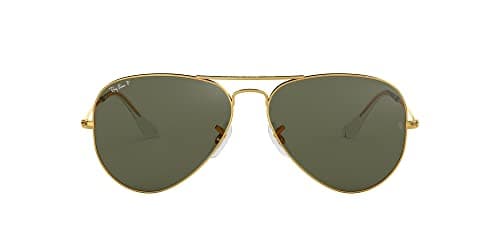
- Ray-Ban Aviator Classic (RB3025, Polarized)— the metal original with the filter. Adjustable nose pads, teardrop lens, and the shape a plastic copy never quite reproduces. Honest con: metal frames are heavier on a long day and the thin temples slide on a sweating face.
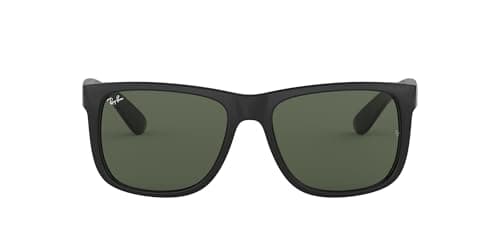
- Ray-Ban Justin (RB4165)— included deliberately as the counter-example. This is the larger, more casual rubberized-nylon frame carrying the classic G-15 lens, and the standard listing is not polarized. It is a good pair of sunglasses and a bad choice if glare off water or a wet road is what you are solving. Read the listing.
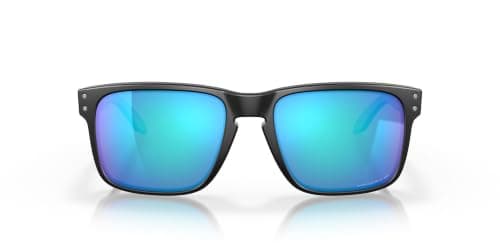
- Oakley Holbrook (Prizm Polarized)— the alternative if you want a lifestyle shape with both polarization and contrast tuning. Same warning in a different wrapper: Prizm is not polarization, so the listing has to say Prizm Polarized.
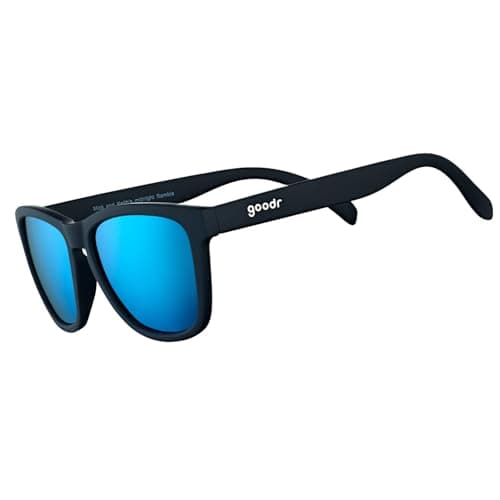
- goodr OG (Polarized)— the answer for anyone who finds all of this exhausting. goodr publishes that every pair in its line is polarized and UV400, so there is no wrong listing to click. Honest con: budget polycarbonate and one size per model - you are buying certainty, not optics.
Are polarized Ray-Bans worth the upgrade?
It depends entirely on what you do in them, and the honest answer splits three ways.
Yes, clearly, if you drive, boat, fish or spend time around snow. Those are all reflected-glare environments, and a polarizing filter removes that reflection rather than simply dimming it - the Cleveland Clinic describes the mechanism plainly. A darker non-polarized lens is not a substitute. If this is you, pay the difference.
No, if the pair is for city wear and looking good. Polarization does nothing for a pair that mostly sees sidewalks and patios, and the non-polarized version of the same frame gives you identical UV protection, which is the part that matters for your eyes. Buying polarization you will not use is the most common way to overspend on Ray-Bans.
Actively no, in a few specific cases. A polarizing filter can dim or black out LCD dashboards and head-up displays at certain head angles, it removes the sheen that warns you about black ice, and it is why plenty of cyclists and golfers avoid polarized lenses altogether. We cover the screen problem in do polarized sunglasses block screens and the sport argument in are polarized lenses good for cycling.
Model by model: the questions people actually type
The autocomplete family for this query is almost entirely per-model - Wayfarer, Justin, Clubmaster, Erika - and the answer is the same for every one of them, which is itself the useful finding: the model does not determine polarization, the listing does.Ray-Ban sells most of its icon frames in several lens configurations, so "is the Wayfarer polarized" has no single answer. The Wayfarer, the Aviator and the Clubmaster all exist in polarized versions; they also all exist in plain-tint versions, frequently at a lower price and frequently sitting next to each other in the same search results.
Two practical consequences. First, a model name in a listing title tells you nothing about the lens - scroll to the lens line. Second, if you are buying a used or gifted pair, the "P" marking on the right lens is the only check that does not require the box.
If you want certainty instead of a lens chart
Some brands remove the decision entirely. Maui Jim and Costa polarize every lens they sell; goodr publishes the same for its whole line. That is a real buying-experience advantage and it is worth something, especially for a gift or for a first polarized pair, which is why those brands show up so often in our men's and women's polarized roundups. If the Maui Jim price is what stopped you going that route, the replacement field is ranked in the best Maui Jim alternatives.
If you want to stay with Ray-Ban, the shortcut is Chromance: always polarized, and contrast-tuned on top. The trade is that it is only sold in Chromance frames, so you are choosing a lens first and a frame second. For how Ray-Ban stacks up against the brands that polarize everything, see Ray-Ban vs Maui Jim, Costa vs Ray-Ban and goodr vs Ray-Ban. The whole range, model by model, is in our Ray-Ban sunglasses review.
One thing polarization is not
It is not UV protection, and the two get conflated in nearly every shop conversation about Ray-Bans. All Ray-Ban lenses provide 100% UV protection whether or not they are polarized, and the American Optometric Association recommends 99-100% UVA and UVB blocking at any price. Choosing the plain-lens Ray-Ban is a comfort decision, not a health one. Choosing an unrated dark lens from an unknown seller is the health one, and it is the wrong call - see UV protection explained.
Before you buy, three checks
1. Read the lens line, not the model name
"Ray-Ban Wayfarer" in a title tells you nothing. The word Polarized has to appear against the lens.
2. Look for the P
A polarized Ray-Ban carries a "P" after the logo on the right lens. On a used or gifted pair this is the only check that works without the box.
3. Decide whether you actually want it
Driving, water, snow → yes, pay the difference. City wear → the plain lens gives you identical UV protection for less. Cycling computers, golf, LCD dashboards → you may want to avoid it on purpose.