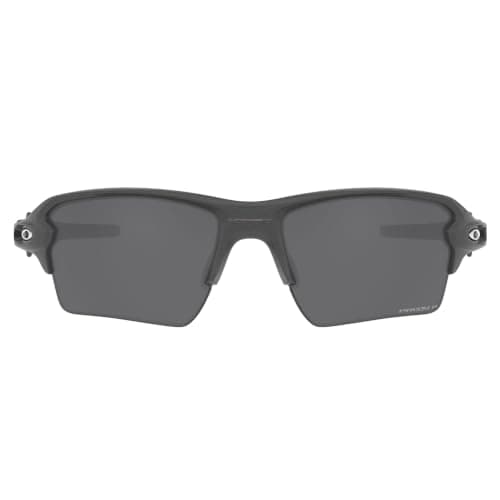
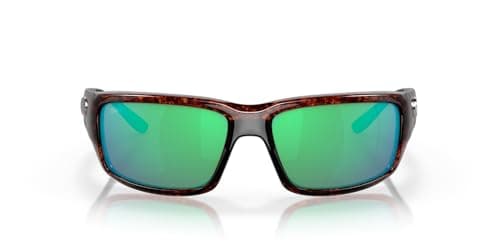
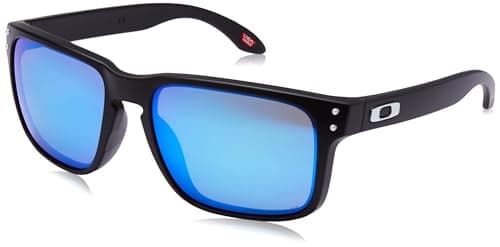
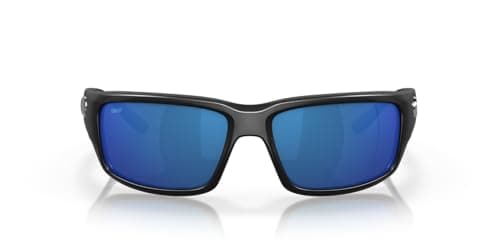
If you spend time on or beside water, buy Costa — the Fantail in 580P is the pick of this page, because every Costa lens is polarized and the 580 tint is engineered for exactly the problem water creates. If you move fast on land — riding, running, golf, trail — buy Oakley, and buy a non-polarized Prizm unless you specifically want the glare filter. Both cost roughly the same, and the deciding question is water versus movement, not brand quality.
These two brands get compared constantly because they overlap in price and in the kind of buyer who reaches that price. They do not overlap in design brief. Costa started as a fishing brand and still behaves like one: the entire lens catalogue is polarized, the tints are specified by water type and light, and the frames carry grip rubber and vents because a wet, salty, sweaty face is the assumed condition. Oakley started as a motocross brand and still behaves like one: lens geometry and retention first, contrast tuning per sport, and polarization treated as one option among many.
| Factor | Costa Del Mar | Oakley |
|---|
| Polarized? | Every lens in the range, by design | An option — much of the Prizm sport range is non-polarized on purpose |
| Lens story | 580 tints that filter specific light to lift contrast in and on water | Prizm tints tuned per environment: road, trail, course, water |
| Lens materials | 580P polycarbonate or 580G glass (the lens etching tells you which) | Plutonite polycarbonate across the range |
| Frame priority | Hydrolite grip, venting, salt tolerance | Unobtainium grip, impact geometry, swappable lenses |
| Coverage | Moderate to full wrap, fishing-shaped | Moderate to goggle-scale, sport-shaped |
| Screens | Always dimmed — a polarized lens is the whole product | Your choice: pick non-polarized Prizm and screens stay readable |
| Best for | Sight-fishing, boating, the beach, driving | Cycling, running, golf, trail, driving |
Costa's real advantage: the whole range is polarized
This is the single most useful fact about the brand and almost nobody knows it. Every pair of Costa sunglasses is polarized. The "P" in 580P does not stand for polarized — it stands for polycarbonate, and as SportRx's breakdown of the 580 range spells out, a lens etched "580" without the P is the glass version. That removes the single biggest buying risk at this price: with Costa you cannot accidentally buy an unpolarized pair, which is entirely possible with Oakley and with Ray-Ban. We go further into the range in are all Costa sunglasses polarized.
On top of that, Costa describes the 580 lens as filtering a specific band of light to lift the contrast anglers care about, with very high polarization efficiency — SportRx quotes 99.9% for the range, and Costa's own lens technology page is the primary claim. Whether you can perceive the difference between a very good polarized lens and an excellent one is a fair question; what is not in doubt is that it is a polarized lens tuned for water, which is what you want if water is your problem.
Oakley's real advantage: you get to choose not to be polarized
Oakley sells Prizm as contrast tuning rather than glare filtering, and keeps polarization as a separate lens choice. That sounds like a weakness next to Costa's always-polarized range until you are riding a bike with a head unit on the bars, reading a rangefinder on a tee, or picking a line through wet rock — all situations where removing surface reflections removes information you were using. This is why so much of the Prizm sport catalogue is non-polarized on purpose, and why polarized lenses are usually the wrong default on a bike.
The second Oakley advantage is serviceability. The sport frames take replaceable lenses, so a scratch costs a lens rather than a pair, and you can run a dark tint in July and a clear one in November on the same frame. Costa frames are not built around consumer lens swapping. If you want the Oakley contrast argument examined on its own, see Oakley Prizm explained.
On the water, it is not close
For sight-fishing, boating, paddling or anything where you are trying to see into water, Costa is the better buy and the choice of glass over polycarbonate is the next decision rather than the brand. Glass (580G) gives you the best scratch resistance and the most optically true view at the cost of weight; polycarbonate (580P) is lighter, cheaper and safer if you might take a hook or a thrown lure. Our glass lens guide argues the trade honestly, including the case against glass for sport. The full water field, including the brands that undercut Costa, is in the fishing sunglasses roundup and best sunglasses for boating.
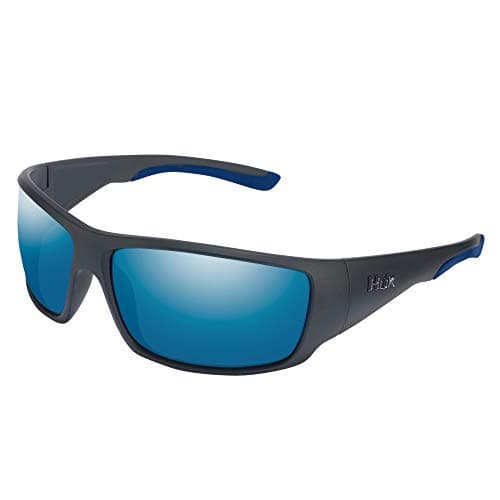
If you want Costa's job done for a quarter of the money, the Huk Spearpoint in the picks above is the honest middle: polarized, mirrored, performance-framed, and a fraction of the price. You lose the 580 tint engineering and some coating life. Our Huk review covers where that compromise bites, and best lens color for fishing matters more than brand at any price.
On land, it depends on the activity — and on the screen
For driving, both brands are excellent and polarization is the feature you want: reflected glare off wet asphalt and car hoods is exactly what the filter removes, as the Cleveland Clinic describes. The Holbrook in Prizm Polarized above is the Oakley answer; the Costa Fantail does the same job in a fishing-shaped frame. For running, riding and golf, Oakley is built for the problem and Costa is not — coverage, grip and lens swapping all favour it. Our Oakley vs Tifosi page covers what you give up by buying Oakley rather than the sport-value brand.
The verdict, stated plainly
Water, every time → Costa, Fantail 580P as the default and 580G if you want glass. Movement on land → Oakley, Flak 2.0 XL for sport and Holbrook for everything else. One pair for both → the Holbrook in Prizm Polarized, with the honest note that a dedicated angler will see more through a Costa. And if the price of either makes you wince, both jobs are 80% done by pairs costing under $60 — see best sunglasses under $100.
How to decide in 30 seconds
Are you trying to see into water?
Yes → Costa. Always polarized, tinted for the job, and the brand the fishing world buys. The mechanism is explained in do polarized sunglasses help you see fish.
Do you read a screen while wearing them?
Yes → Oakley, non-polarized Prizm. Costa has no non-polarized option, so a dimmed chartplotter or head unit is a permanent condition.
Do you need to swap lenses with the seasons?
Oakley. Replaceable sport lenses are a real feature and Costa does not compete there.
Glass or polycarbonate?
Costa offers both — 580G glass for optics and scratch resistance, 580P polycarbonate for weight and impact safety. Oakley is polycarbonate (Plutonite) across the range.
Is the budget tight?
Then buy neither: a polarized mirrored performance frame at a fifth of the price keeps the glare filter and most of the usefulness. The compromise is coating life and tint engineering.