Top pick
Top pick
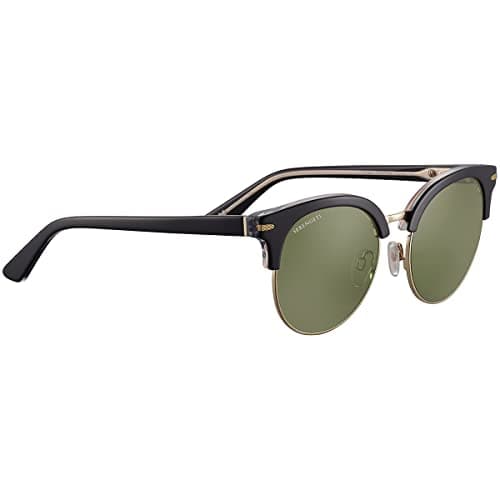
Serengeti Susan (Mineral Polarized 555nm)
Best for: The cheapest live route into mineral glass
The alternative that beats Ray-Ban where Ray-Ban is weakest: the lens. Polarized Corning borosilicate mineral glass with a 555nm contrast tint and published 99.9% glare elimination, in a lifestyle frame, for well under the price of a polarized Ray-Ban. Best for everyday wear and driving where you want the optics to be the point.
Budget pick
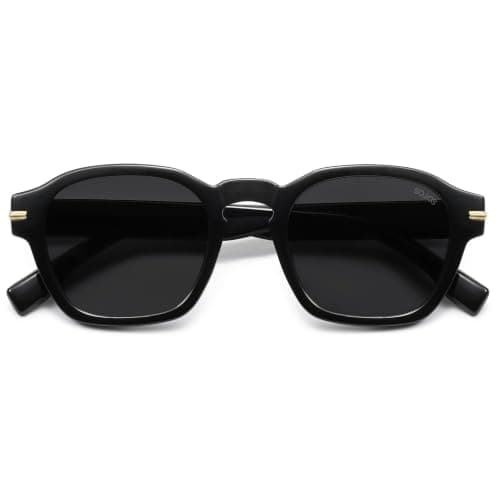
SOJOS Retro Square Polarized
Best for: A cheap, on-trend everyday pair
The pick if what you wanted was the shape rather than the lens. A cheap, on-trend polarized square at a tiny fraction of Ray-Ban money - the right way to test whether a silhouette suits you before spending real money on it.
#ad · we may earn a commission. Live prices from the Amazon Product API, as of November 23, 2026. Where we have no verified live price we show none.
The best Ray-Ban alternative for most people is the Serengeti Susan: polarized mineral glass with a published contrast tint, which is a straightforwardly better lens than anything in the Ray-Ban range, in a lifestyle frame, for less than a polarized Ray-Ban. Best for everyday wear and driving. If you want the icon-shape feel with a documented contrast lens and do not mind premium money, the Oakley Holbrook Prizm Polarized is the pick. If you want a genuinely polarized everyday pair with a lifetime defect warranty for a fraction, buy the Tifosi Swank XL. And the budget pick is the SOJOS retro square, which gets you the silhouette for pocket money. Seven picks below, with live prices and the date they were checked.
Three different people search this, and they want three different things. Some want a better lens: they bought Ray-Bans for quality and found out the lens is the least special part. Some want the same look for less, having discovered what a Wayfarer costs. And some want a shape Ray-Ban does not do well on their face. This page ranks for the first group and is explicit about the other two.
What you are actually replacing
Be fair about it, because Ray-Ban is better than the internet tends to say — just better at different things than people assume. What you are really buying is three things. The first is the shapes: the Wayfarer, the Aviator and the Clubmaster are among the most recognisable objects in consumer design, and nothing here replaces that. The second is the frame itself — the acetate and metal builds are genuinely good, and a Ray-Ban frame survives years of ordinary wear. The third is availability: you can try one on almost anywhere, which matters more than spec sheets for a lifestyle frame.
The lens is the part that is merely competent, and the detail matters. Per SportRx's Ray-Ban lens guide, G-15, B-15 and solid Blue are offered in crystal or polycarbonate, with polarized VLT published at 11% for G-15, 12% for B-15, 16% for Blue Solid, 9% for Silver Mirror and 18-43% across the gradients; Copper Mirror is non-polarized only; and Chromance lenses “are all polarized, polycarbonate, and only available in Chromance frames”. The critical practical point is in the same guide, verbatim: “All Ray-Ban Polarized lenses feature a distinctive ‘P’ after the Ray-Ban logo on the right lens”. Polarization is a per-listing option here rather than a brand standard, which is a real difference from Costa, Bajío or Maui Jim — and we have a whole page on it in are Ray-Bans polarized.
One more published fact worth knowing before you shop: Ray-Ban warrants against manufacturing defects for 24 months, with lens scratches treated as normal wear and excluded. Three brands on this page publish defect cover for the life of the product instead.
How we ranked these
- Lens, first. This is the axis on which Ray-Ban is beatable, so it leads. Polarized mineral glass with a contrast tint ranks above a documented contrast polycarbonate, which ranks above a competent budget polarized lens.
- Whether polarization is standard. Not having to decode a listing is worth something, and several picks here polarize everything they sell.
- Whether it is a lifestyle frame. A sport wrap is not an alternative to a Wayfarer no matter how good the lens is. Everything here is wearable off a bike.
- Warranty, as published. 24 months is the bar to beat, and three picks here beat it.
- Price, honestly bracketed. Every number is live and date-stamped. One pick costs about what a Ray-Ban costs and is here on merit; the rest are cheaper, some by an order of magnitude.
| If you are replacing Ray-Ban because… | Buy | What you give up |
|---|
| You want a genuinely better lens | Serengeti Susan (mineral glass, 555nm) | Glass weight, and a much narrower frame range |
| You want the icon feel with a documented lens | Oakley Holbrook (Prizm Polarized) | Barely any money — and you must check it says Polarized |
| You want polarized-as-standard plus a lifetime warranty | Tifosi Swank XL (Brown Polarized) | No contrast platform; reads sportier than a Wayfarer |
| You want something between budget and premium | NEVEN Polarized Rectangular | No published lens documentation at all |
| You wanted the Aviator shape, and you run | goodr Polarized Aviator | Optical clarity, materials and any sense of occasion |
| You want the icon shape for a fraction | Knockaround Rounded Square Polarized | Ordinary optics and coarse fit, with a real warranty |
| You are testing whether a shape suits you | SOJOS Retro Square Polarized (budget pick) | Everything except polarization and UV400 |
The short answer
Quick picks
#ad · Live prices from the Amazon Product API, as of November 23, 2026. Where we have no verified live price, we show none — we would rather leave a gap than print a number that has rotted.
In detail
The picks, in full
The cheapest live route into mineral glass
Serengeti Susan (Mineral Polarized 555nm)
Mineral glass lensPolarized555nm contrast tintAcetate and metal frame
Serengeti's mineral glass at the lowest price the brand actually sells it for — in a feminine cat-eye rather than a driving frame.
- Glare control
- 9
- Optics
- 9
- Fit & coverage
- 5
- Durability
- 8
- Value
- 8
Pros
- +Real mineral glass for well under half what the fishing-glass brands charge — the cheapest glass lens on this site by a wide margin
- +The 555nm Spectral Control tint targets the wavelength the eye resolves best, which reads as a lift in contrast rather than a color cast
- +Polarized as well as photochromic — Serengeti splits its range into photochromic-only and polarized models, and this SKU carries both
Cons
- −Category 3 to 3: the published 18%-12% transmission range means it deepens within an already-dark tint and never clears to a light lens
- −A 53mm feminine cat-eye in acetate and metal — a styling frame with modest coverage and no grip material, not a unisex driving wrap
- −Serengeti's Amazon stock is thin and moves between models, so the colorway you see today may not be the one in stock next month
Don't buy this if…
…you want one pair that covers a dark afternoon and a dim morning, or a wrap for the water or the bike. This is a fixed-category glass lens in a lifestyle frame, and side light gets straight past it.
Driving, water and everyday Oakley wear
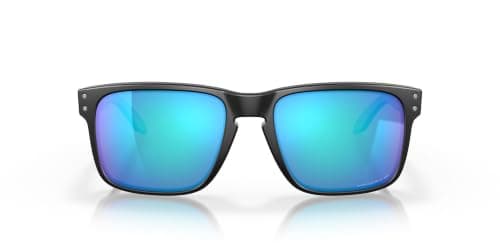
Oakley Holbrook (Prizm Polarized)
Prizm Sapphire PolarizedOO9102 HolbrookPlutonite lensSquare lifestyle frame
Oakley's polarized option in its most wearable frame — the version to buy if you are not buying Oakley for sport.
- Glare control
- 9
- Optics
- 9
- Fit & coverage
- 6
- Durability
- 9
- Value
- 5
Pros
- +Polarization and Prizm contrast tuning in one lens, so you are not choosing between glare control and contrast
- +The Holbrook is the Oakley frame that looks least like sports equipment, which is what most polarized buyers actually want
- +Plutonite and Oakley's frame build are why these survive years of daily wear rather than a season
Cons
- −A real premium over the non-polarized Prizm version of the same frame, for a filter a $25 lens also has
- −Flat-ish lifestyle shape lets side light in — it is not a wrap and does not pretend to be
Don't buy this if…
…your main use is cycling, golf or any sport where you read a head unit or a subtle surface reflection. Oakley leaves most of its sport lenses non-polarized on purpose, and here the polarized upgrade works against you.
Wider faces on a budget
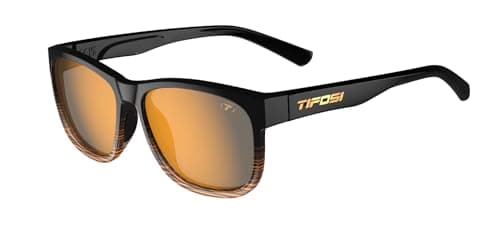
Tifosi Swank XL (Brown Polarized)
Injected polarized lensXL sizingBrown contrast tintUV400 polycarbonate
A genuinely polarized Tifosi in the frame built for wider faces — the answer when the standard Swank pinches and you still want glare control.
- Glare control
- 8
- Optics
- 7
- Fit & coverage
- 8
- Durability
- 7
- Value
- 9
Pros
- +Solves two problems at once: the standard Swank is too narrow for a lot of faces, and the standard lens is not polarized
- +The brown polarized tint lifts contrast on grass and water more than a neutral smoke lens does
- +Tifosi builds the polarization in as an injected layer rather than a surface coating, so it is the same lens construction as the rest of its polarized range and cannot rub off
Cons
- −Only a handful of XL colorways carry the polarized lens and the in-stock set moves around — check the colorway line says polarized rather than assuming the frame color you want has it
- −A brown tint shifts colors warm, which some people dislike for driving at dusk
- −Still a lifestyle shape: side light gets in, and it is not a substitute for a wrap
Don't buy this if…
…the standard Swank already fits you. The XL is a width fix, and buying up a size you do not need just makes the frame slide.
A mid-price everyday polarized pair
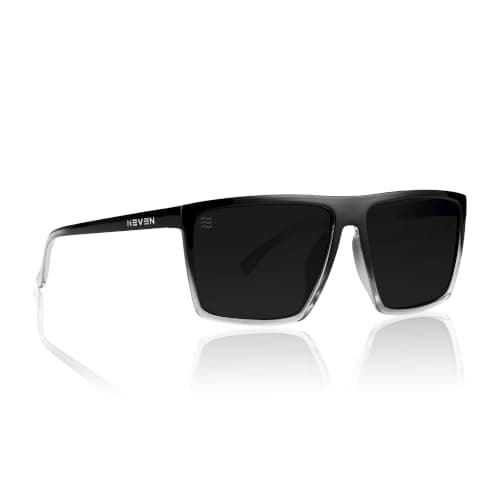
NEVEN Polarized Rectangular
PolarizedUV protectionRectangular shapeCoastal styling
A coastal-styled polarized rectangle from a smaller brand, priced between budget and premium.
- Glare control
- 8
- Optics
- 7
- Fit & coverage
- 6
- Durability
- 7
- Value
- 7
Pros
- +Sits in the gap most brands ignore — better built than the sub-$20 field, far below premium money
- +A rectangular shape is the safe, broadly flattering choice for rounder and softer faces
- +Polarized, so it does the real job on wet roads and around water
Cons
- −A smaller brand means less published lens documentation than the big names offer
- −No contrast tuning — this is a general-purpose glare lens, not a fishing or course lens
Don't buy this if…
…you want a documented lens technology to compare. The established brands publish far more about what their lenses actually do.
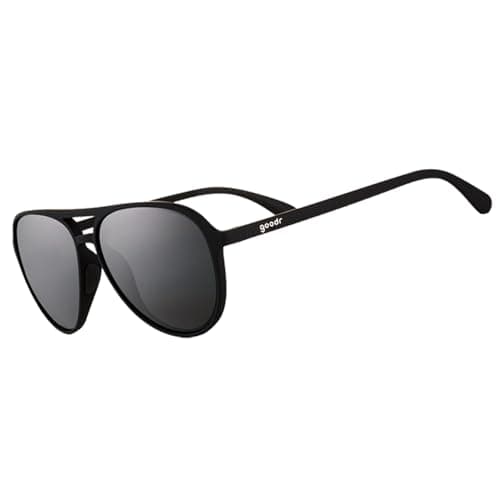
Aviator shape that survives a run
goodr Polarized Aviator
PolarizedUV400Aviator shapeNo-slip grip
goodr's take on the aviator — the icon shape with the grip coating and none of the icon price.
- Glare control
- 8
- Optics
- 7
- Fit & coverage
- 8
- Durability
- 7
- Value
- 9
Pros
- +The teardrop shape that flatters square and angular faces, in a frame that actually stays on when you sweat
- +Polarized and UV400 like the rest of the goodr line, at a fraction of a metal aviator's price
- +Light enough to forget, unlike a metal-framed aviator on a long day
Cons
- −A plastic aviator does not have the presence or the adjustable nose pads of the metal original
- −Budget coatings; treat it as a season-or-two frame rather than a keeper
Don't buy this if…
…you want the genuine article. If the aviator matters to you as an object, the metal original is what you actually want.
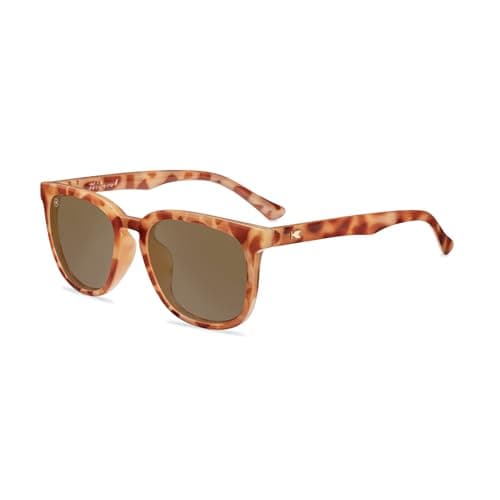
Softening a square or angular face on a budget
Knockaround Rounded Square Polarized
Rounded square shapePolarizedUV400Impact-resistant
The softened-corner Knockaround — the budget answer for a face that hard squares are too harsh on.
- Glare control
- 8
- Optics
- 7
- Fit & coverage
- 7
- Durability
- 7
- Value
- 9
Pros
- +Rounded corners take the hard edge off a square frame, which is the standard counterweight to a strong jawline
- +Polarized and UV400 at a price where owning two shapes is reasonable
- +Knockaround's impact-resistant build survives the life a cheap pair actually gets
Cons
- −Budget coatings will scratch before a premium lens does
- −One size within the shape, with no adjustment
Don't buy this if…
…your face is already round or soft. A rounded frame on a round face echoes the curve instead of balancing it.
A cheap, on-trend everyday pair
SOJOS Retro Square Polarized
PolarizedUV400Square retro shapeTAC lens
A trend-led polarized frame at a price that makes it an easy yes.
- Glare control
- 7
- Optics
- 6
- Fit & coverage
- 6
- Durability
- 5
- Value
- 10
Pros
- +Polarized and UV400 for the price of lunch — the fundamentals are covered
- +The retro square shape is a current look without a designer price
- +Light and comfortable for all-day casual wear
Cons
- −TAC (film-laminate) lens optics and coatings are budget-grade
- −Fashion-first build; not made for sport or abuse
Don't buy this if…
…you want optical precision or a pair that lasts years. This is a fun, replaceable everyday frame.
Who each pick is for, and what is wrong with it
- Serengeti Susan (Mineral Polarized 555nm) — Best for: the cheapest live route into mineral glass, in a lifestyle frame. The pick of this page because it wins on the axis Ray-Ban is weakest on. Serengeti publishes Corning borosilicate mineral glass described as 20% thinner and lighter than standard glass, with Spectral Control, photochromic behavior and 99.9% glare elimination, and the 555nm tint targets the wavelength the eye resolves best, which reads as contrast rather than a color cast. Published Abbe values put mineral glass at 58-59 against polycarbonate at 30. Honest cons:glass is heavier and breaks where polycarbonate deforms; the frame range is a fraction of Ray-Ban's; and the photochromic behavior means it sits lighter behind a windshield than you expect, because laminated glass blocks much of the UV that triggers it. The head-to-head is Serengeti vs Ray-Ban, and the brand in full is the Serengeti review.
- Oakley Holbrook (Prizm Polarized) — Best for: driving, water and everyday Oakley wear. The alternative for someone who wants the icon-object feeling with engineering behind the tint. Per Oakley's Prizm documentation, Prizm is a contrast-tuning platform rather than a uniform darkener, and the Holbrook is the lifestyle shape in the range. Honest cons:it costs about what a Ray-Ban costs, so this is a swap rather than a saving; and Prizm is not polarization — Rx Safety's explainer is the clearest statement of why that matters, so you have to buy the listing that says Prizm Polarized. Our matchup is Ray-Ban vs Oakley.
- Tifosi Swank XL (Brown Polarized) — Best for: wider faces on a budget, with a warranty. The value pick of this page and the answer to the most common complaint about Ray-Ban: that polarization costs extra and the warranty runs out. This is genuinely polarized as the listed spec, at a small fraction of a polarized Ray-Ban, and Tifosi publishes a warranty against manufacturer defects for the life of the product, with buyable replacement lenses and nose pieces. Honest cons:no contrast-lens platform and no published VLT; the frame reads sportier than a Wayfarer does; and the XL fit is wrong on a narrow face — the standard Swank is the pair to look at then.
- NEVEN Polarized Rectangular — Best for: a mid-price everyday polarized pair. The pick that fills the gap this market usually leaves empty: between thirty dollars and a hundred and fifty there is very little, and this sits in it. Polarized, UV-protective, better built than the sub-$20 field, in a rectangular shape that is the broadly flattering safe choice. Honest cons:a smaller brand means almost no published lens documentation — no VLT, no Abbe figure, no named platform; no contrast tuning; and no published warranty. Our write-up is the NEVEN review and the verdict is are NEVEN sunglasses good.
- goodr Polarized Aviator — Best for: the aviator shape that survives a run. The specific answer for anyone whose Ray-Ban Aviators kept sliding off. goodr publishes polarization, UV400 and a no-slip grip coating across its range, so this is the aviator silhouette you can actually move in, and you cannot buy an unpolarized one by mistake. Honest cons: the lens is a decent polarized lens and nothing more, there is one size per model, the coatings are a season-or-two proposition, and nobody will mistake it for an icon. The matchup is goodr vs Ray-Ban.
- Knockaround Rounded Square Polarized — Best for: softening a square or angular face on a budget. The icon shape at a small fraction of the money, polarized and UV400, and Knockaround publishes lifetime cover for manufacturing defects after a 45-day return window — one claim per paid pair, as store credit. That is a longer published defect term than Ray-Ban's 24 months, at a fraction of the price. Honest cons: the optics are ordinary, the fit range is coarse, the materials feel like the price, and the warranty will not help with a dropped or lost pair. Knockaround vs Ray-Ban is the full comparison.
- SOJOS Retro Square Polarized — Best for:the budget pick, and testing a shape. The cheapest honest way to find out whether a silhouette suits your face before you spend real money on it — polarized and UV400, which are the two specs that matter, and nothing else. Honest cons: build, hinges, coatings and fit are exactly what the price implies, and there is no warranty. It is a trial pair and a spare pair, not a replacement for a frame you wear daily. If shape is the real question, best sunglasses for a round face and best sunglasses for a square face are the pages to read.
Brands similar to Ray-Ban, ranked by how similar they actually are
- Oakley— the closest on being an icon brand with real engineering, and the one where you must read the listing carefully. Ray-Ban vs Oakley.
- Serengeti— similar in silhouette, much better on lenses, far smaller in range. Serengeti vs Ray-Ban.
- Maui Jim— not similar on styling, extremely similar on who buys them and why; a lens brand rather than a frame brand. Ray-Ban vs Maui Jim.
- Knockaround and goodr— the same shapes at a fraction, with ordinary optics and better warranties than you would expect. goodr vs Knockaround.
- Tifosi— the value option: polarized as standard on the right listings, with published lifetime defect cover.
Model by model: what to buy instead of the Ray-Ban you had
Instead of a Wayfarer or New Wayfarer
The Knockaround Rounded Square at a fraction, the Tifosi Swank XL if you want polarized-as-listed plus a lifetime warranty, or the Serengeti if the lens is what you care about. Honest note: if the Wayfarer silhouette itself is the point, the closest thing to a Wayfarer is a Wayfarer, and are Ray-Bans worth it is the page that argues both sides.
Instead of an Aviator
The goodr Polarized Aviator if you move in them, or a polarized metal frame if you do not. The aviator shape is widely copied and copied well, so this is the Ray-Ban model where the saving is largest for the least compromise.
Instead of a Justin or a polarized Chromance
You are paying for a polarized polycarbonate lens in a lifestyle frame, which is exactly what the Tifosi Swank XL and the NEVEN rectangle are — for a fraction. Chromance is a genuinely good lens; it is also polarized-only and frame-locked, which narrows your choice.
Instead of a Clubmaster
This is the hardest shape to replace honestly, because the browline silhouette is specific and few budget brands execute it well. If the browline is the requirement, keep the Ray-Ban and buy a cheaper second pair for the beach and the car. There is no shame in a two-pair answer, and it is usually the cheaper one.
Is a cheap pair as good as a Ray-Ban?
On the two functional essentials, yes, and we are not going to pretend otherwise. Polarization is close to binary — the Cleveland Clinic describes it as a filter that removes reflected light, and a $20 polarized lens removes it. UV is the same story: the American Optometric Association recommends 99-100% UVA and UVB blocking regardless of spend, and every pick here publishes UV400. What a cheap pair does not match is the frame build, the coating life, the fit precision and the feeling of wearing a well-made object, which is a real thing to want even though it is not a spec. The arithmetic that decides it is hours per year on your face, and are expensive sunglasses worth it does it properly.
Choosing in four questions
Are you replacing the lens or the look?
The lens → Serengeti, for mineral glass, or Oakley for a documented contrast tint. The look → Knockaround or SOJOS, and keep the difference.
Do you need it to be polarized?
Driving, water, snow → yes, and check for the “P” if you stay with Ray-Ban. Screens, head-up displays, golf → possibly not; start at polarized vs non-polarized.
Will they be on your face while you move?
Yes → goodr, for the grip coating; a Wayfarer slides the first time you sweat. No → buy on lens and fit instead.
How many pairs do you lose?
More than one in three years → the budget pick is the correct answer, not a compromise. None → the premium alternatives genuinely pay back over a decade.
If it is one silhouette you are replacing rather than the brand, the Wayfarer has its own shortlist — mostly cheaper acetates, plus one glass upgrade — at Ray-Ban Wayfarer alternatives.
How we picked
We don't run a testing lab
We compile each pair's published specifications — lens material, polarization, coating, frame material, coverage, UV rating and price — normalize them, and score each against a published rubric. The scores are judgments from documented research; they are notmeasurements we took, because we don't own a lab and we're not going to pretend we do. Pairs we claim to have lab-tested: 0.
Questions
Frequently asked
What brand is similar to Ray-Ban but cheaper?+
Knockaround, for the icon shapes at a small fraction of the money — and it publishes lifetime cover for manufacturing defects, which is longer than Ray-Ban's published 24 months. Tifosi is the pick if you want polarized as the listed spec plus a lifetime defect warranty, and goodr is the pick if the pair needs to stay on while you move. The full matchup is
Knockaround vs Ray-Ban.
Which sunglasses have better lenses than Ray-Ban?+
Serengeti and Maui Jim, clearly, because both build around polarized mineral glass with a published contrast tint — published Abbe values put mineral glass at 58-59 against polycarbonate at 30. Oakley is ahead on documented contrast tuning with Prizm. Ray-Ban's crystal G-15 is a good lens; it is just not a contrast platform, and polarization is a per-listing option rather than a standard.
Are Ray-Bans polarized?+
Some are. Polarization is a per-listing option across most Ray-Ban tints rather than a brand standard, and SportRx's lens guide states that all Ray-Ban polarized lenses carry a distinctive “P” after the logo on the right lens. Chromance lenses are all polarized but only come in Chromance frames. Our full explanation is
are Ray-Bans polarized.
What is the best Ray-Ban Aviator alternative?+
The goodr Polarized Aviator if the pair needs to stay put while you move, because goodr publishes a no-slip grip coating across its range and polarizes everything it sells. The aviator is the Ray-Ban shape that is copied best, so it is also where the saving is largest for the least compromise.
How long is the Ray-Ban warranty compared with the alternatives?+
Ray-Ban publishes 24 months against manufacturing defects in material or workmanship, with lens scratches treated as normal wear and excluded. Tifosi and Knockaround both publish defect cover for the life of the product, with similar exclusions - neither covers a dropped or lost pair. So the difference matters most to someone who keeps a frame for many years rather than to someone who breaks them.
Receipts
Sources
- SportRx - Ray-Ban lens guide (published lens chart: G-15, B-15 and solid Blue offered in crystal or polycarbonate; polarized VLT G-15 11%, B-15 12%, Blue Solid 16%, Blue Mirror 11%, Silver Mirror 9%, gradients 18-43%; Copper Mirror non-polarized only; Chromance lenses “are all polarized, polycarbonate, and only available in Chromance frames”; verbatim: “All Ray-Ban Polarized lenses feature a distinctive ‘P’ after the Ray-Ban logo on the right lens”)
- Ray-Ban / Luxottica - published warranty terms (warranted free from manufacturing defects in material or workmanship for 24 months from purchase, measured from delivery for orders placed on or after 1 July 2023; lens scratches treated as normal wear and excluded, as is damage from accident, misuse, neglect or unauthorized repair)
- Serengeti - published lens technology (Corning borosilicate mineral glass described as 20% thinner and lighter than standard glass, Spectral Control, photochromic behavior, 99.9% glare elimination)
- Oakley - Prizm lens technology (official)
- Rx Safety - Oakley Prizm vs Polarized: what the two technologies each do
- Tifosi Optics - warranty information (official, verbatim: Tifosi will “warranty any sunglass against manufacturer’s defects to the original owner for the life of the product”; excludes normal wear and tear, lost, stolen, dropped, shattered, scratched or sat-on product, excludes scratched lenses, US residents and original purchaser only, does not cover prescription sunglasses, and carries a shipping and handling fee per claim)
- Knockaround - warranty policy (official: 45-day returns, then lifetime cover for manufacturing defects, one claim per paid pair, store credit at original purchase price, no cover for loss, theft, accidental damage or ordinary wear)
- goodr - published product claims (polarized, UV400 and a no-slip grip coating across the range)
- OptoGrid - Abbe value by lens material (CR-39 58, mineral glass 58-59, polycarbonate 30)
- American Optometric Association - UV protection and sunglasses guidance (99-100% UVA and UVB blocking recommended at any price)
- Cleveland Clinic - polarized vs non-polarized sunglasses (polarization described as a filter that removes reflected, horizontally oriented light)
We do not run a testing lab, and we do not pretend to. Where a spec or measurement came from a manufacturer or a third party, we name and link it. Where we could not verify something, we say so on the page rather than quietly leaving it out. Read our full method.